









Solid-State Battery Applications in Electric Vehicles
Release time: 2026-03-19
This electric vehicle primarily uses ternary lithium batteries or lithium iron phosphate batteries, with battery capacities ranging from approximately 50.3kWh to 61.13kWh. The NEDC pure electric range is available in three versions: 400km, 420km, and 500km. The battery features liquid cooling technology and supports both fast charging (approximately 30-40 minutes to 80%) and slow charging.
As new energy vehicles rapidly popularize, “range anxiety” and “battery safety” remain the two core pain points for end-users. As an explorer and practitioner of cutting-edge battery technology, Prism Mark is committed to bringing advanced solid-state battery technology from the lab to commercial mass production.
This case study details the successful application of Prism Mark’s advanced battery solutions in a mainstream pure electric vehicle project. By equipping our high-performance battery system, this vehicle achieves a perfect balance of range, safety, and charging efficiency.
Core Challenges and Customer Requirements
The customer aimed to create a pure EV combining high safety, long range, and controllable costs to meet the dual needs of urban commuting and inter-city travel. Traditional liquid batteries pose thermal runaway risks when facing extreme temperatures and physical damage, which served as the precise breakthrough point for the Prism Mark technical team.
Prism Mark Customized Battery Solutions
Based on the customer’s vehicle positioning, Prism Mark provided a dual-track, high-performance battery solution. By integrating our profound technical accumulation in advanced electrolyte materials (such as LATP/LLZO solid electrolytes), we significantly elevated the safety boundaries of the entire battery pack.
1. Flexible Cell Matrix Design
To accommodate various vehicle trims, we customized two powertrain systems for this project, covering a total battery capacity ranging from 50.3kWh to 61.13kWh:
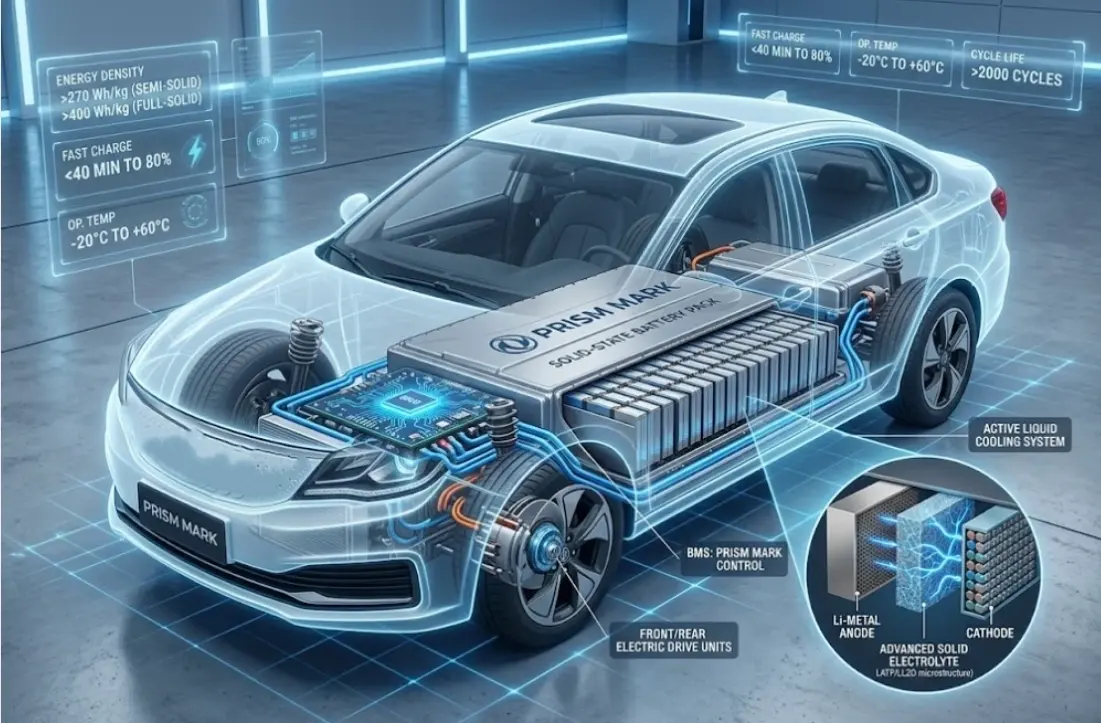
- High-Energy Ternary Lithium Version (50.8kWh – 61.13kWh): Introduced semi-solid/hybrid solid-liquid electrolyte technology, boosting cell energy density to the 230-270 Wh/kg level. While ensuring ultra-high safety, it provides more robust power output and excellent lightweight performance for high-end models.
- High-Safety Lithium Iron Phosphate (LFP) Version: Targeted at entry-level and optimized 2021 models, utilizing Prism Mark’s unique high-specific-energy LFP technology. Combined with a robust structural design, it maximizes both cost-effectiveness and ultimate safety.
2. Outstanding Range and Replenishment Performance
- True NEDC Range: By optimizing the pack’s volume utilization and lightweight design, this vehicle matrix achieves pure electric NEDC ranges of 400km, 420km, and 500km, accurately covering users’ daily and long-distance travel scenarios.
- Ultra-Fast Charging Experience: Employing high-conductivity materials and optimized electrode interface designs significantly reduces battery internal resistance. It supports highly efficient DC fast charging, taking only 0.6 to 0.62 hours (about 36-40 minutes) to charge from low up to 80%; paired with a standard slow charging pile, it takes 6-9 hours to fully revive using off-peak overnight electricity.
3. All-Weather Liquid Cooling Temperature Control System
The introduction of solid and semi-solid materials inherently grants the battery a wider operating temperature range. Building on this, Prism Mark equipped the system with a highly efficient liquid-cooling power battery temperature control system. Whether in the scorching heat of midsummer or the severe cold of -20°C, the thermal management system maintains the cells in their optimal operating range, effectively extending battery cycle life (capacity retention remains excellent even after >2000 cycles).

Redefining “Ultimate Safety”
Safety is the foundational color of the Prism Mark brand. During the battery pack R&D and testing phase for this vehicle, the Prism Mark battery system passed a series of stringent safety tests that far exceed national standards:
- Nail Penetration and Crush Tests: The hybrid solid-liquid electrolytes and flexible solid electrolyte separators used fundamentally inhibit the growth of lithium dendrites. In the 5mm steel nail penetration test, the cell achieved an outstanding performance of “no fire, no explosion, and no severe thermal runaway.”
- Extreme Abuse Tests: Covering overcharge, over-discharge, 150°C high-temperature heating, and even short circuit and heavy impact tests. Prism Mark batteries maintained a stable physical and chemical structure, forging a solid safety defense line for users’ lives.
Future Outlook: Marching Towards the All-Solid-State Era
With the successful implementation of this project, Prism Mark has once again proven our delivery capabilities in the commercialization of new energy. Currently, based on this mature application experience, Prism Mark’s next-generation all-solid-state battery (utilizing ultra-thin metallic lithium anodes, with energy density breaking through 400-500 Wh/kg) has also achieved major breakthroughs in the lab and on pilot lines.
In the future, Prism Mark will continue to be technology-driven, working alongside global partners to provide lighter, farther-reaching, and safer ultimate power solutions for EVs, high-end power applications, and aerospace sectors.
About Prism Mark
Prism Mark is an innovative enterprise dedicated to the R&D of advanced battery materials and full-pack system integration. We focus on the industrialization of high-specific-energy solid-state batteries, hybrid solid-liquid batteries, and key materials, striving to empower a zero-carbon future with technology.