









Solid-State Battery Phone Application
Release time: 2026-03-19
In today’s increasingly homogeneous smartphone market, screens are getting more stunning, and processors more powerful, but one pain point always remains—battery anxiety. To achieve longer battery life, we have to endure thicker and heavier devices; to pursue faster charging, we have to face the potential risks of overheating and even catching fire.
At Prism Mark, we constantly focus on cutting-edge technologies that can truly subvert user experience. Today, we turn our attention to what is hailed as the “ultimate form of the next-generation battery”—solid-state battery technology.
Pain Points & Breakthroughs: The “Ceiling” of Traditional Liquid Lithium Batteries
Current smartphones generally use liquid lithium-ion batteries. After more than a decade of development, their energy density is approaching its physical limit (usually around 250Wh/kg). This leads to a contradiction in smartphone design: if you want long battery life, you must cram in a large, heavy battery, turning the phone into a “brick”; if you pursue a slim profile, you can only sacrifice battery life and carry a power bank with you.
In addition, liquid electrolytes are naturally flammable. When subjected to external crushing, puncturing, or high temperatures, they are highly prone to thermal runaway, leading to the safety hazard of fire and explosion.
Prism Mark believes that the key to breaking this deadlock is the all-solid-state battery.
Prism Mark Selection: Core Parameter Matrix of Next-Gen Solid-State Batteries
Before diving into the specific experience, let’s intuitively feel the multidimensional advantage of solid-state batteries with a set of hardcore data from top-tier laboratories:
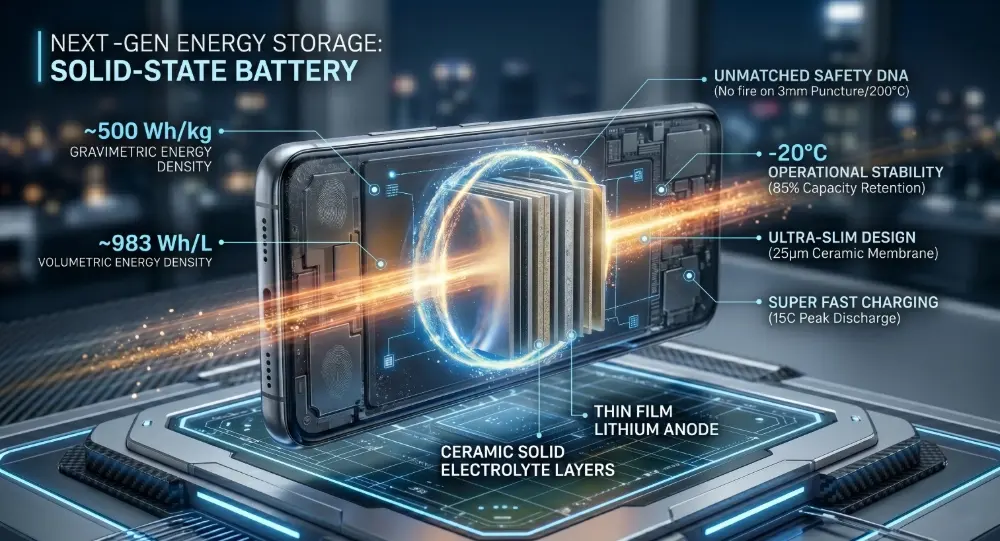
- Gravimetric Energy Density: Breaks through 400 Wh/kg, reaching up to 500 Wh/kg (far exceeding the 250 Wh/kg of traditional batteries).
- Volumetric Energy Density: Up to 983 Wh/L (significantly reducing volume at the same capacity).
- Ultimate Safety Performance: 100% passes 3mm steel needle puncture (25mm/s), 13KN crushing, and 200℃ high-temperature heating, with no fire and no explosion throughout the process.
- Ultra-Wide Temperature Range: Under extreme low temperatures of -20℃, the capacity retention rate remains as high as 85%.
- Ultra-High Discharge Rate: Continuous discharge rate >5C, supporting extreme peak discharge of up to 15C.
- Core Material Breakthrough: New LATP/LLZO solid electrolytes with an ionic conductivity of 1.5 mS/cm, and an ultra-thin ceramic membrane with a thickness of only 25µm.
Scenario Analysis: When Top-Tier Solid-State Battery Parameters Translate to User Experience
If the top-tier solid-state battery technology mentioned above is applied to the next generation of flagship smartphones, what qualitative changes will our user experience undergo?
1. Breaking Physical Limits: 500Wh/kg Brings “Two-Day Battery Life” and Ultimate Slimness
Benefiting from the use of ultra-thin lithium metal anodes and revolutionary solid electrolytes, the energy density of the next-generation solid-state batteries has taken a leap. Not only is the gravimetric energy density as high as 500Wh/kg, but its volumetric energy density has also reached an astonishing 983Wh/L.
User Experience: This means that within the exact same volume as existing phone batteries, the battery capacity can easily be doubled (e.g., leaping from 5000mAh to a staggering 10000mAh), completely achieving “two days per charge.” Alternatively, while maintaining the current battery life, the thickness of the phone battery can be halved. Coupled with the 25µm ultra-thin ceramic membrane technology already broken through in the laboratory, future smartphones could return to being truly “paper-thin,” freeing up extremely precious internal space for foldable phones.
2. Absolute Safety DNA: Fearless of 3mm Steel Needle Puncture and 200℃ High Temperature
Smartphones are our most personal electronic devices, making safety paramount. Solid-state batteries have completely abandoned flammable liquid electrolytes, adopting non-flammable solid electrolyte materials (such as LATP nano-slurry with an ionic conductivity of up to 1.5 mS/cm).
User Experience: In extreme CNAS third-party safety tests, this solid-state battery delivered a perfect score of “no fire, no explosion, no leakage” when faced with a 3mm steel needle penetrating at 25mm/s, 13KN strong crushing, or even continuous heating from 130℃ to 200℃. For users, this means that whether the phone accidentally falls from a height and suffers a severe impact, or is forgotten in a sun-baked car during midsummer, the probability of triggering a catastrophic accident will be infinitely close to zero.
3. All-Weather Online: Maintaining 85% Strong Power Even at -20℃
Have you ever experienced your phone suddenly losing power and shutting down outdoors on a cold winter day? This is a common flaw of liquid lithium batteries, where the electrolyte viscosity increases and activity decreases at low temperatures.
User Experience: Thanks to breakthroughs in high-performance solid electrolyte materials, the new solid-state batteries exhibit excellent wide-temperature operation capabilities. Test data shows that in an extreme low-temperature environment of -20℃, the solid-state battery can still maintain over 85% power output. Whether skiing in a freezing winter or exploring extreme climates, a smartphone equipped with a solid-state battery will be your never-failing, reliable companion.
4. Instant Recovery: Super Fast Charging Supporting 15C Extreme Discharge
High specific energy solid-state battery technology is not only large in capacity, but its dynamic performance is equally astonishing. Through core surface solidification technologies such as artificial SEI films, the next-generation solid-state batteries have significantly reduced interfacial impedance.
User Experience: Parameters show that the advanced solid-state battery’s continuous discharge rate is greater than 5C, and it can even handle an extreme discharge of up to 15C. Applied to smartphones, this means it can withstand extremely high-power super-fast charging inputs, completing 0-100% energy replenishment in a very short time. Moreover, thanks to the high thermal stability of solid electrolytes, the heat generated during high-power fast charging will be substantially reduced, which not only protects the phone’s motherboard but also greatly extends the battery’s cycle life.
Conclusion
From an energy density of up to 500Wh/kg to the absolute safety of not catching fire when punctured, the solid-state battery is no longer just a concept on a PowerPoint presentation. It is solidly reshaping our understanding of portable energy storage through tangible test data.
By integrating the technologies of the world’s leading lithium ecological supply chains, we have seen the infinite potential of solid-state batteries in high-end smart devices. At Prism Mark, we firmly believe that future smartphones will not only be computing and imaging centers but will also be absolutely safe, always-online super terminals.
Say goodbye to battery anxiety and embrace slimness and safety. The solid-state battery era of smartphones is about to fully begin.