









Solid-State Battery vs Lithium Polymer Battery
Release time: 2026-07-14
Isi Kandungan
The global transition toward electrification has placed unprecedented demands on energy storage systems. From the smartphones in our pockets to the electric vehicles (EVs) revolutionizing our highways, the need for safer, denser, and longer-lasting power sources is undeniable. For over a decade, the market has been dominated by liquid and gel-based lithium architectures. However, when discussing the absolute frontier of this industry, one specific innovation dominates the conversation: the bateri keadaan pepejal.
As engineers and product designers look toward the future, they frequently find themselves at a technological crossroads. They must choose between the reliable, well-understood legacy systems and the highly anticipated, revolutionary alternatives. This comprehensive guide will deeply explore the mechanics, advantages, disadvantages, and future trajectories of these two vital technologies, providing a clear roadmap for the future of portable power.
Understanding the Incumbent: Lithium Polymer (LiPo) Technology
Before we can look to the future, we must understand the present. Lithium Polymer technology, frequently referred to simply as LiPo, represents a significant evolution from the traditional cylindrical lithium-ion cells (like the ubiquitous 18650).
How LiPo Works
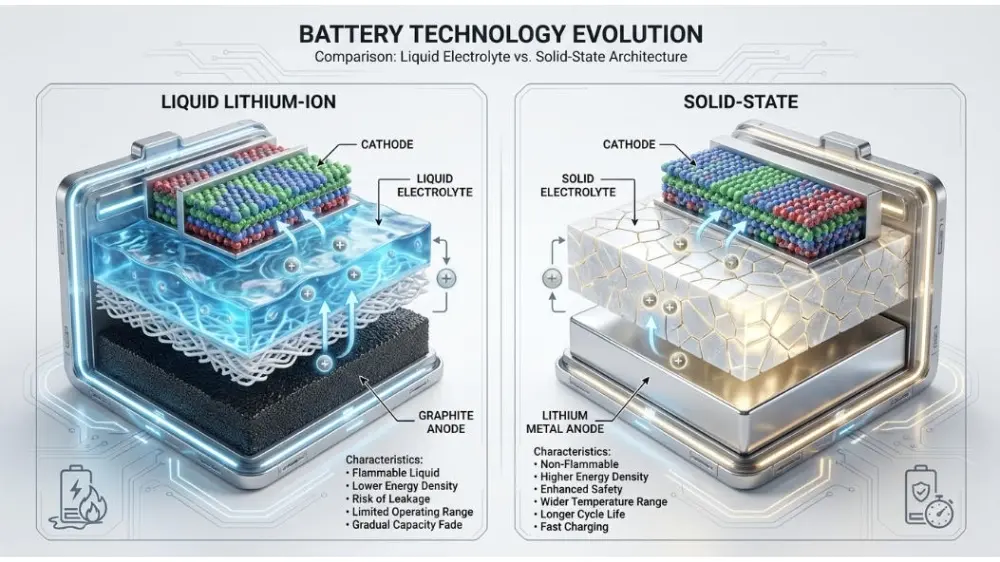
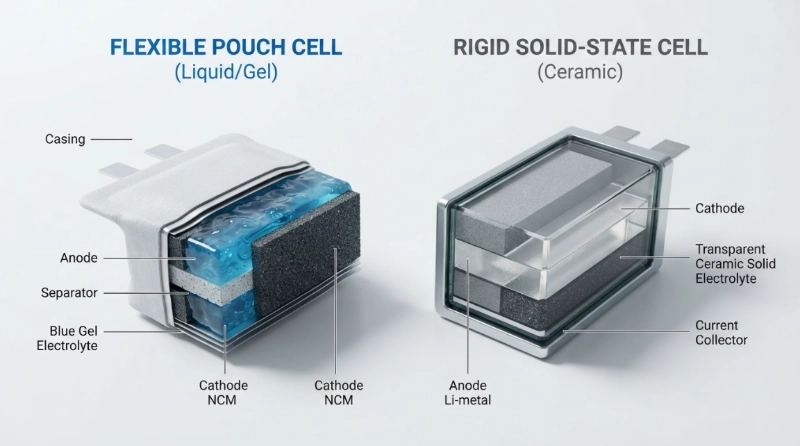
At its core, a LiPo cell operates on the same fundamental chemical principle as standard lithium-ion cells: lithium ions shuttle back and forth between a positive electrode (cathode) and a negative electrode (anode) during charge and discharge cycles. The critical distinction lies in the electrolyte.
Instead of using a highly volatile, completely liquid solvent, LiPo cells utilize a polymer electrolyte. This material is typically a semi-solid, gel-like substance (often polyethylene oxide or polyacrylonitrile). This gel provides the necessary medium for the lithium ions to travel through while allowing the cell to be packaged in a flexible, foil-like pouch rather than a rigid metal casing.
The Advantages of Legacy Gel-Polymer Systems
The widespread adoption of this architecture is not accidental. It offers several compelling benefits that have made it the go-to choice for the consumer electronics and drone industries for years:
- Form Factor Flexibility: Because they do not require rigid cylindrical casings, these cells can be manufactured in almost any shape or size, fitting perfectly into the incredibly tight, custom confines of modern ultrabook laptops and flagship smartphones.
- Lightweight Construction: The absence of heavy metal enclosures results in an exceptionally high gravimetric energy density (energy per unit of weight). This is why the radio-controlled (RC) aircraft and drone communities rely almost exclusively on this technology.
- High Discharge Rates: Certain chemical formulations of these pouch cells can dump their stored energy incredibly fast, providing the massive instantaneous amperage required by performance drones and high-speed portable tools.
The Inherent Drawbacks
Despite their dominance, liquid and gel-based systems suffer from inherent chemical limitations:
- Safety Vulnerabilities: The gel electrolyte remains flammable. If the cell is punctured, overcharged, or exposed to extreme heat, it can experience a phenomenon known as “thermal runaway,” leading to catastrophic fires.
- Cell Swelling: Over time, or due to misuse, the internal chemistry can break down and generate gas. Because the pouch is flexible, it expands, often physically pushing the screen out of a smartphone or damaging the chassis of a laptop.
- Degradation: The liquid/gel components degrade relatively quickly with each charge cycle, significantly reducing the total capacity of the cell after just a few years of regular use.
The Challenger: The Solid-State Revolution
The technological paradigm shift currently underway revolves around removing the liquid or gel entirely. By replacing the flammable organic solvents with a rigid, non-flammable solid material, researchers have unlocked a new tier of electrochemical performance.
The Mechanics of Solid Electrolytes
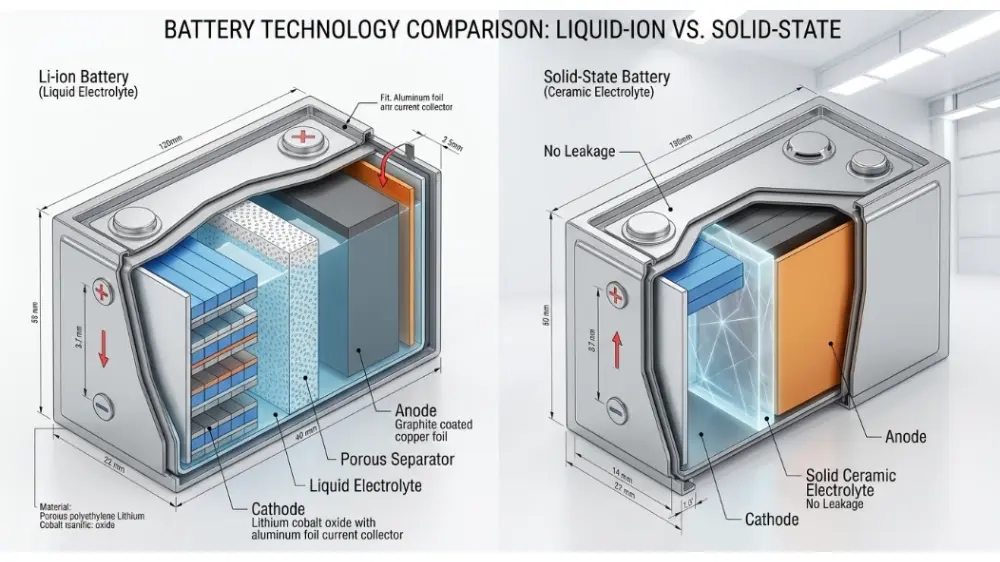
In a solid-state architecture, the separator and the liquid electrolyte are replaced by a single solid layer. This layer can be composed of various advanced materials, including ceramics, specialized glass, or solid polymers.
This solid layer still allows the crucial lithium ions to pass through it during charging and discharging, but it acts as a physical barrier that prevents the electrodes from ever touching, while entirely removing the flammable liquids from the equation.
Why This is a Generational Leap
The transition to solid architectures is not merely an incremental upgrade; it solves several fundamental bottlenecks in energy storage:
- Enabling Lithium Metal Anodes: Traditional cells use graphite for the anode to house the lithium ions. Solid electrolytes are strong enough to suppress the formation of “dendrites” (microscopic, needle-like metallic spikes that grow during charging and can short-circuit a liquid battery). This allows manufacturers to use pure lithium metal as the anode, drastically increasing the amount of energy the cell can hold.
- Absolute Safety: Without flammable liquids or gels, the risk of thermal runaway is virtually eliminated. These cells can be punctured, crushed, or exposed to high heat without catching fire.
- Extreme Temperature Tolerance: Solid materials do not freeze like liquids at low temperatures or boil and vaporize at high temperatures, allowing devices to operate efficiently in extreme climates.
Head-to-Head: A Detailed Solid-State Battery vs Lithium Polymer Analysis
When evaluating these two architectures side-by-side, we must look across several distinct engineering vectors. In any comprehensive solid-state battery vs lithium polymer assessment, the nuances of manufacturing scale, physical safety, and volumetric efficiency dictate which technology a product designer will choose.
1. Safety Profile and Thermal Stability
The most critical vector of comparison is undoubtedly safety. LiPo cells require complex, heavy, and expensive Battery Management Systems (BMS) and thermal cooling arrays (especially in electric vehicles) to ensure they do not overheat. The gel electrolyte is a fire hazard waiting for an ignition source (like a short circuit caused by physical damage).
Conversely, solid architectures are inherently inert. Because the electrolyte is a non-flammable ceramic or glass, it acts as a permanent firebreak. This means that EV manufacturers can drastically reduce the weight and complexity of their cooling systems, reallocating that weight savings to even more energy storage.
2. Energy Density: Volumetric and Gravimetric
Energy density is measured in two ways: how much energy fits in a specific space (volumetric, Wh/L) and how much energy fits in a specific weight (gravimetric, Wh/kg).
Currently, high-end LiPo systems max out at roughly 250-300 Wh/kg. They are light, but they take up physical space. Because solid architectures allow for the use of dense lithium metal anodes, they are projected to easily surpass 400 Wh/kg, and potentially reach 500 Wh/kg in the near future. This means a solid cell of the exact same physical size as a traditional gel cell could hold up to twice as much power, or a cell with the same power could be half the size.
3. Cycle Life and Longevity
Every time you charge and discharge a device, micro-degradation occurs. In gel-based systems, the chemical reactions slowly consume the active lithium, and the gel itself degrades. A standard high-capacity pouch cell might retain 80% of its original capacity after 500 to 1,000 cycles.
Solid architectures, particularly those utilizing advanced ceramic separators, suffer from significantly less degradation. Because the physical structure is rigid and there are no liquids to evaporate or break down, these next-generation cells are projected to easily survive 5,000 to 10,000 cycles. For a consumer, this means a device that lasts a decade without needing a replacement power source.
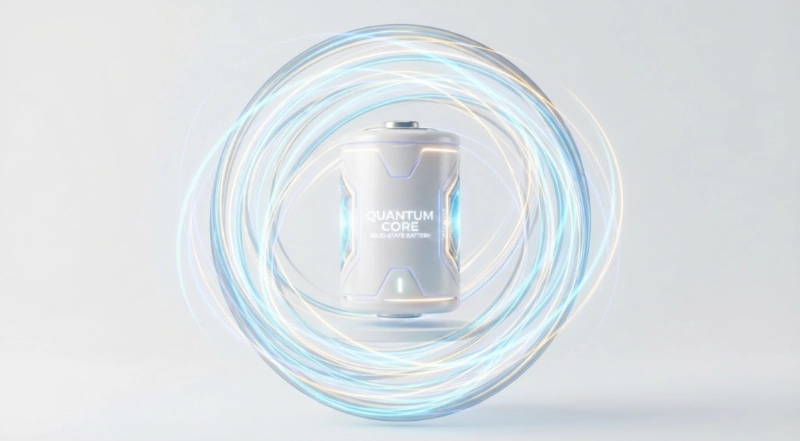
4. Form Factor and Micro-Electronics
While pouch cells are flexible, they still require a minimum thickness to accommodate the necessary layers of gel and separators safely without short-circuiting.
For hardware engineers seeking a thin battery solution for next-generation smartcards, ultra-thin wearable medical sensors, and biometric tracking patches, solid electrolytes are the definitive answer. Because the solid layer can be manufactured at a microscopic thickness (often deposited via thin-film vapor deposition), manufacturers can create functional, high-capacity energy storage that is thinner than a piece of paper, all without the risk of the cell swelling over time.
5. Cost and Manufacturing Scalability
This is where the incumbent technology holds a massive, albeit temporary, advantage. The global supply chain, tooling, and manufacturing facilities for gel-polymer and traditional lithium-ion systems represent hundreds of billions of dollars in sunk costs and optimized processes. LiPo is incredibly cheap to produce at scale today.
Solid architectures are still largely in the pilot-production phase. Manufacturing highly uniform, defect-free ceramic or glass electrolytes at a massive scale is technically difficult and incredibly expensive. Until economies of scale are achieved—likely towards the end of this decade—solid options will remain a premium component reserved for high-end electric vehicles and luxury electronics.
Core Metric Comparison Summary
To provide a clear, scannable summary for technical decision-makers, the following table breaks down the fundamental differences between the two architectures as they stand in the current manufacturing landscape.
| Ciri / Metrik | Lithium Polymer (Gel-Based) | Solid-State Architecture |
|---|---|---|
| Keadaan Elektrolit | Semi-liquid / Gel Polymer | Solid (Ceramic, Glass, or Solid Polymer) |
| Ketumpatan Tenaga Maksimum | ~250 – 300 Wh/kg | ~400 – 500+ Wh/kg (Projected) |
| Profil Keselamatan | Moderate (Risk of thermal runaway & swelling) | Extremely High (Non-flammable, no swelling) |
| Kitaran Kehidupan | 500 – 1,000 cycles | 5,000 – 10,000+ cycles |
| Operating Temperatures | Narrow (Degrades in extreme hot/cold) | Very Broad (Functions well in sub-zero and high heat) |
| Kos Pembuatan Semasa | Low (Highly mature, massive global scale) | High (Emerging technology, pilot-scale production) |
| Aplikasi Utama | Drones, Smartphones, Laptops, RC devices | Next-gen EVs, Aerospace, Micro-medical devices |
The Future of Industry Applications
How will these differences reshape specific industries over the next ten years? The integration of these new chemistries will not happen simultaneously across all sectors.
Consumer Electronics and Wearables
The smartphone and laptop markets are highly sensitive to price. While Apple, Samsung, and others are heavily investing in solid research, they will likely continue using optimized gel-pouch cells for mid-tier devices for several years. However, for flagship devices, the allure of a phone that lasts three days on a single charge and never suffers from “battery bloat” will drive early adoption. Furthermore, the micro-wearable sector (like smart contact lenses or advanced hearing aids) will adopt thin-film solid cells almost immediately, as liquid architectures simply cannot be miniaturized effectively for these use cases.
The Electric Vehicle (EV) Sector
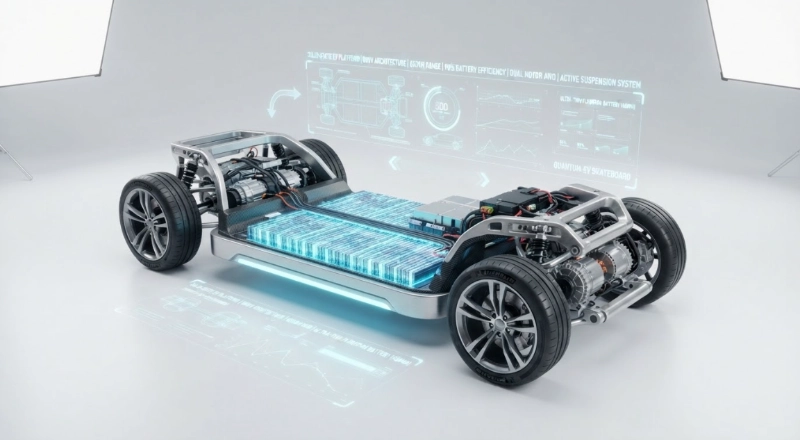
This is the primary battleground. “Range anxiety” and safety concerns regarding vehicle fires remain the two largest hurdles to global EV adoption. Automakers like Toyota, Volkswagen (QuantumScape), and Nissan are pouring billions into commercializing solid architectures for their vehicles.
When an EV can utilize a solid architecture, the vehicle becomes lighter (due to fewer cooling systems required), can charge from 10% to 80% in under 15 minutes (as the lack of heat generation allows for massive fast-charging currents), and can safely drive over 600 miles on a single charge. This technological leap will arguably be the final nail in the coffin for the internal combustion engine.
Aerospace and High-Performance Drones
Weight is everything in aerospace. While the RC hobbyist market will likely stick with cheap gel-polymer systems due to their high discharge rates and low cost, commercial aerospace (like electric Vertical Takeoff and Landing – eVTOL aircraft) absolutely requires the safety and gravimetric density of solid technology. A fire mid-air is catastrophic, making the inert nature of solid electrolytes a mandatory requirement for future electric aviation regulation.
Conclusion and Final Verdict
The transition of energy storage technologies is not a matter of jika, tetapi bila. As demonstrated in this LiPo battery comparison, legacy technologies still hold immense value for budget-conscious manufacturing, extremely high-discharge applications, and current-generation consumer goods. They are cheap, reliable, and well-understood.
However, the ultimate ceiling for liquid and gel-based chemistries has largely been reached. To push the boundaries of what is possible in electric mobility, aerospace, and miniaturized smart technology, the industry must move to solid architectures. While manufacturing costs and scalability remain significant hurdles today, the undeniable benefits in absolute safety, doubled energy density, and virtually infinite cycle life ensure that solid-state technology will be the undisputed champion of the next decade of power engineering.
Soalan Lazim
To further clarify the transition between these two critical technologies, here are answers to the most common questions asked by consumers and hardware developers.
1. Is a solid-state battery available to buy right now?
For the average consumer, large-scale solid cells (like those meant for smartphones or cars) are not yet readily available on the commercial market. The technology is currently in the pilot-production phase, being tested heavily by major automakers and tech giants. However, micro-sized, thin-film solid cells are currently being manufactured and utilized in specialized medical implants and IoT (Internet of Things) sensor tags. Mainstream commercialization for cars and phones is widely expected between 2026 and 2028.
2. Why do traditional pouch cells swell up over time, and will new solid technologies do the same?
Traditional pouch cells swell due to a process called “outgassing.” As the liquid or gel electrolyte breaks down over hundreds of charge cycles—or if the cell is exposed to high heat or overcharging—it produces flammable gases like oxygen and carbon dioxide. Because the pouch is sealed and flexible, it expands like a balloon. Solid architectures do not contain these volatile liquid or gel compounds. Therefore, they do not produce gas when they degrade, completely eliminating the risk of swelling.
3. Will the transition to solid electrolytes make electric vehicles cheaper?
In the short term, no; they will likely debut in expensive luxury electric vehicles first due to the high initial costs of new manufacturing equipment. However, in the long term (post-2030), they are expected to significantly reduce the cost of EVs. Because they are inherently safe, automakers can remove the heavy, expensive armored casings and complex liquid-cooling systems currently required to keep traditional lithium-ion systems safe. Simplifying the vehicle architecture will ultimately drive the total manufacturing cost down.