









مقارنة السلامة: بطاريات الحالة الصلبة مقابل بطاريات الإلكتروليت السائل
Release time: 2026-07-21
جدول المحتويات
The rapid electrification of modern society, spearheaded by the widespread adoption of electric vehicles (EVs) and grid-scale energy storage, has brought electrochemical technology to the forefront of global innovation. While energy density and ultra-fast charging speeds often dominate consumer headlines, the most critical factor determining the long-term viability and public acceptance of these technologies is fundamental safety. For decades, the tech industry has relied on established wet-cell architectures. However, highly publicized incidents of catastrophic thermal failures have accelerated the urgent global search for a كيمياء بطاريات أكثر أمانًا. This relentless pursuit has naturally led researchers away from traditional volatile systems and toward next-generation solid architectures. Understanding the microscopic and macroscopic differences in how these power cells react under extreme stress is essential for engineers, consumers, and policymakers alike.
The Anatomy of Conventional Energy Storage
To fully appreciate the massive advancements in modern cell design, one must first understand the internal workings and inherent vulnerabilities of traditional power sources. At its core, a conventional lithium-ion cell consists of a positive electrode (cathode), a negative electrode (anode), a microscopic porous synthetic separator, and an organic chemical solvent that allows lithium ions to shuttle back and forth during charge and discharge cycles.
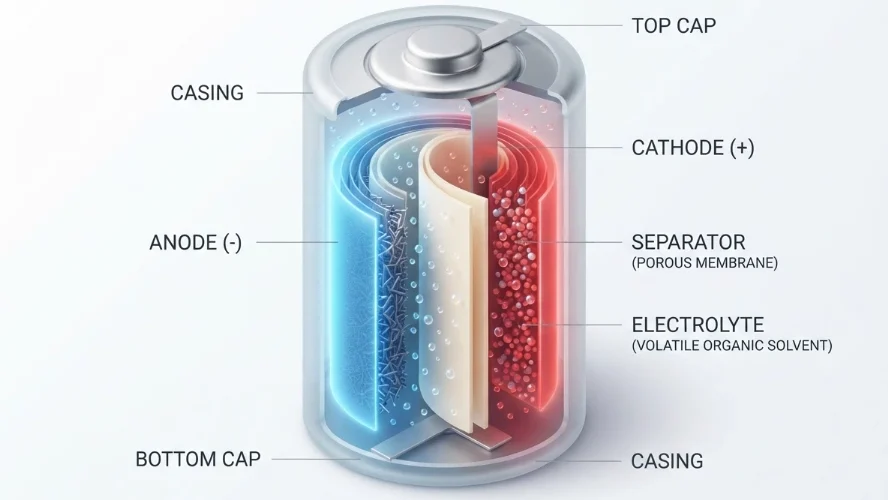
This solvent is the lifeblood of the cell, providing excellent ionic conductivity even at room temperature. However, this same component is also its greatest Achilles’ heel. The standard بطارية إلكتروليت سائل relies on a cocktail of organic carbonates (such as ethylene carbonate and dimethyl carbonate) mixed with lithium salts like LiPF6. These chemicals are inherently volatile, highly flammable, and extremely prone to rapid decomposition under thermal, mechanical, or electrical stress. When these liquids degrade under high heat, they generate combustible gases, creating a highly pressurized, hazardous environment inside the sealed cell casing.
The Mechanics of Thermal Runaway
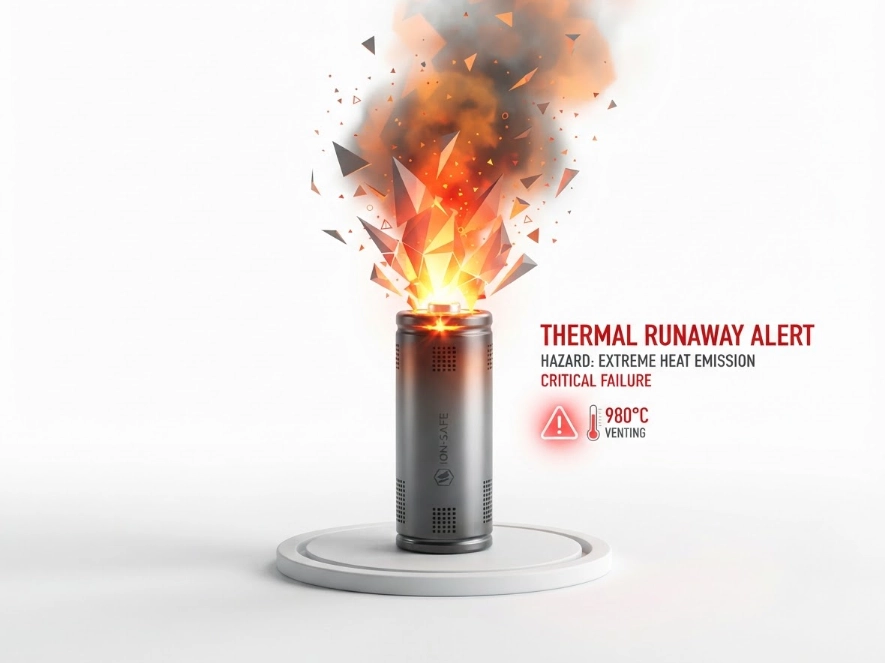
The primary safety threat in traditional energy storage is a phenomenon known as “thermal runaway.” This is a terrifying, self-sustaining chemical chain reaction that is notoriously difficult to stop once initiated.
Thermal runaway typically begins with a localized internal fault—perhaps a microscopic manufacturing defect, a tiny metal contaminant, or severe physical trauma from a vehicle collision. As the internal temperature of the damaged cell rises past 80°C (176°F), the volatile organic solvents begin to vaporize, causing the cell to swell. By the time the internal temperature reaches roughly 120°C to 130°C, the thin polymer separator that keeps the highly reactive anode and cathode apart begins to melt and shrink.
Once the separator breaches, a direct internal short circuit occurs. This releases the entire stored kinetic energy of the cell in a matter of milliseconds. Temperatures instantly spike above 600°C (1112°F), igniting the vaporized organic solvents and releasing highly toxic, flammable gases, including hydrogen fluoride (HF) and carbon monoxide. Extinguishing such a chemical fire is notoriously difficult because the cathode’s breakdown generates its own oxygen, effectively feeding the fire from within and rendering traditional fire suppression foams and blankets nearly useless.
The Solid-State Revolution: A Paradigm Shift
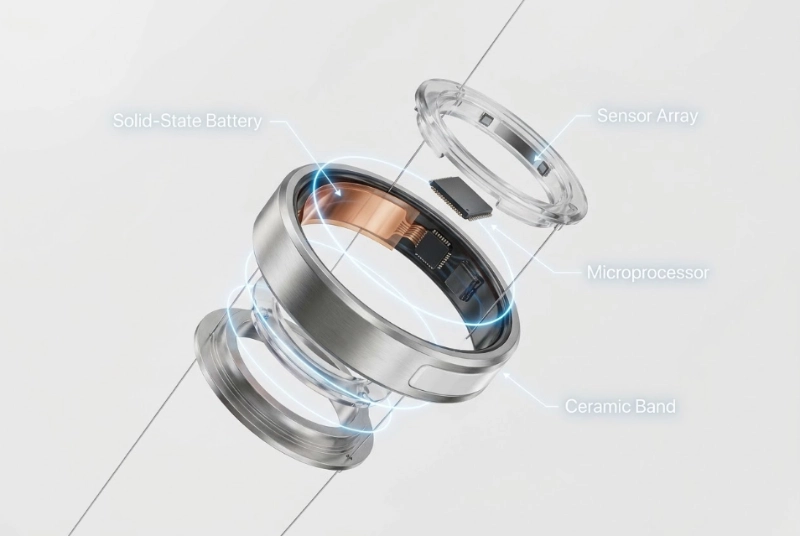
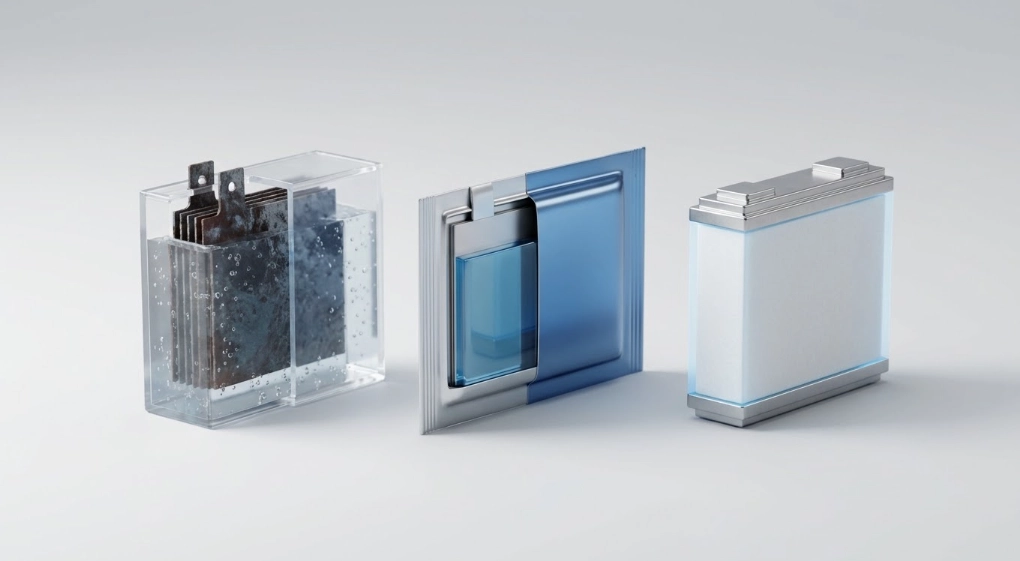
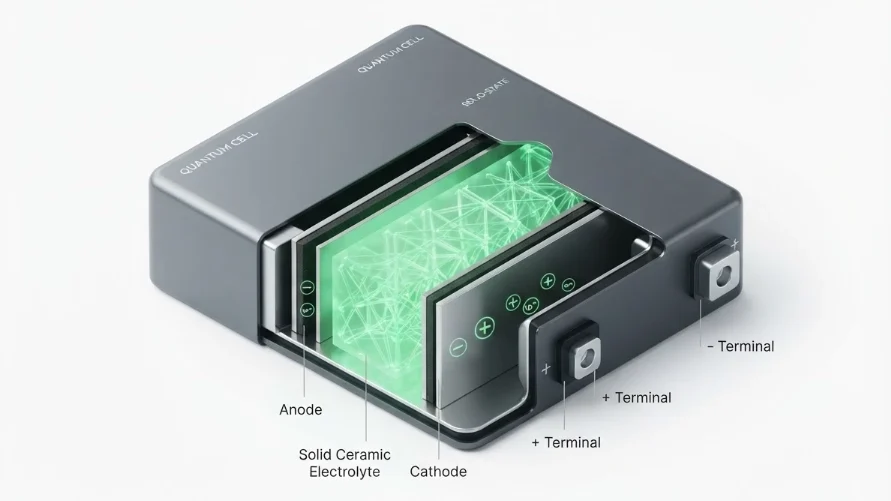
By fundamentally re-engineering the internal environment and entirely removing the flammable solvent, scientists have completely altered the safety paradigm. In these advanced cells, the liquid is replaced by a rigid, non-flammable solid material. This solid component serves a dual purpose: it acts as both the ionic conductor allowing power to flow, and the physical separator keeping the electrodes apart.
Without volatile organics, the primary fuel source for thermal runaway is completely eradicated. Even when exposed to extreme external heat, massive overcharging, or severe physical crushing, these solid components remain remarkably stable, resisting chemical decomposition up to temperatures exceeding 300°C.
Overcoming the Dendrite Threat
Beyond flammability, the second major safety hurdle in standard lithium-ion technology is the formation of lithium dendrites. When a cell is charged too rapidly, or operated in freezing temperatures, lithium ions can fail to absorb smoothly into the anode. Instead, they plate onto the surface, forming sharp, needle-like metallic structures known as dendrites. Over time and repeated charging cycles, these microscopic spears grow outward, eventually piercing the porous polymer separator of a wet cell and causing a catastrophic internal short.
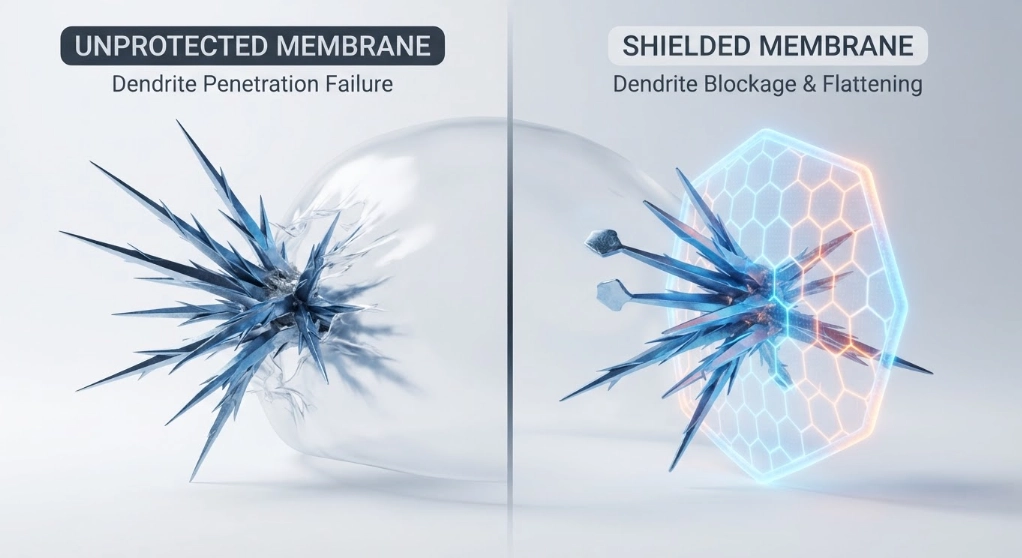
Solid electrolytes offer a massive mechanical advantage here. Materials like Lithium Lanthanum Zirconium Oxide (LLZO) possess an exceptionally high shear modulus, meaning they are physically hard enough to act as an impenetrable barrier. They mechanically block dendrite penetration, forcing the lithium to plate evenly.
Standardized Abuse Testing and Structural Integrity
To truly quantify the risk profiles of different energy storage systems, automotive engineers subject them to standardized, extreme abuse testing (such as UN 38.3 or UL 1642 certifications). When conducting a rigorous أمان بطاريات الحالة الصلبة comparison against traditional models, the results from tests like nail penetration and hydraulic crushing are strikingly different.
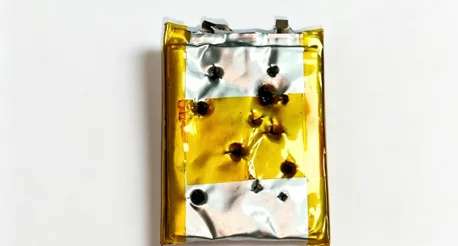
During a nail penetration test—which simulates a severe crash where a sharp foreign object pierces the cell casing—a conventional wet cell immediately shorts out. The liquid boils instantly, and the cell erupts in a violent jet of sparks and toxic flame. Conversely, when a solid-state cell is pierced by the same steel nail, the localized short circuit generates minimal heat because the surrounding solid ceramic or polymer does not vaporize or catch fire. The physical damage remains highly localized; the cell simply stops functioning, perhaps registering a slight, harmless temperature increase, but entirely avoiding catastrophic combustion.
مقارن
To clearly illustrate the technical differences, the following table breaks down the core safety profiles of both architectures under extreme conditions:
| Safety Metric / Characteristic | Traditional Liquid Architecture | Advanced Solid Architecture |
|---|---|---|
| Primary Flammability | High (Highly volatile organic solvents) | Zero to Low (Non-flammable ceramics/polymers) |
| عتبة الهروب الحراري | ~130°C (Separator melts, rapid ignition) | >300°C (Highly stable chemical structure) |
| Dendrite Penetration Risk | High (Soft polymer separator easily pierced) | Very Low (High shear modulus mechanically blocks growth) |
| Toxic Gas Release (Off-gassing) | Severe (Releases Hydrogen Fluoride and Carbon Monoxide) | Minimal (No liquid solvent to vaporize) |
| Puncture / Crush Reaction | Catastrophic (Explosion and aggressive self-sustaining fire) | Localized failure (Cell dies quietly without ignition) |
System-Level Safety and Thermal Management
The superior thermal stability of these advanced non-liquid cells has secondary safety benefits that ripple throughout the entire system architecture. Modern electric vehicles must allocate a massive amount of weight, space, and energy to highly complex active cooling systems. These systems pump hundreds of liters of liquid coolant through intricate channels between cell modules to ensure the system remains within a very narrow, safe operating window (typically 20°C to 40°C).
Because solid ceramics are virtually immune to standard thermal runaway triggers, these heavy, expensive, and leak-prone cooling mechanisms can be drastically simplified. A passive cooling approach, or a vastly reduced active system, reduces the risk of electrical shorts caused by coolant leaks inside the pack. Furthermore, eliminating this complex plumbing lightens the vehicle significantly, indirectly boosting driving range and improving physical crash-test dynamics.
Examining Different Solid Materials
It is important to note that not all solid architectures are identical; different materials offer varying degrees of safety and performance:
- الإلكتروليتات القائمة على البوليمر: These are incredibly stable and easy to manufacture at scale. However, they typically only conduct ions efficiently at elevated temperatures (above 60°C). They are exceptionally safe for grid-scale storage where temperature can be managed, but less practical for consumer smartphones.
- Oxide-Based Ceramics (e.g., LLZO): These offer the absolute highest level of chemical stability and safety. They are virtually unburnable. However, they are highly brittle, making them difficult to manufacture in the thin, flexible layers required for automotive applications without cracking under vehicle vibration.
- Sulfide-Based Glasses: These offer ionic conductivity that rivals or even exceeds traditional liquids. While they are vastly safer regarding fire risk, they present a unique chemical challenge: if the cell casing is breached and the sulfide material is exposed to ambient atmospheric moisture, it can generate toxic hydrogen sulfide (H2S) gas. Therefore, while fire risk is eliminated, robust hermetic sealing remains critically important.
Broader Industries Demanding High-Security Power
While the automotive sector is the loudest advocate and primary financial backer of this technology, other specialized industries are equally desperate for a كيمياء بطاريات أكثر أمانًا. In aerospace and commercial aviation, the extreme ambient pressure changes at 35,000 feet can cause liquid-filled cells to swell, leak, or spontaneously combust—a scenario that represents an unmitigated disaster mid-flight. Solid architectures eliminate these low-pressure outgassing and leakage risks entirely.
Similarly, in the advanced medical field, implantable biomedical devices like pacemakers, neural stimulators, and internal drug-delivery systems require energy sources that pose absolutely zero chemical leakage risk to the human body. The inert, highly stable nature of ceramics makes them the perfect, zero-tolerance candidate for deep-tissue implantation.
Manufacturing Realities and the Transition Phase
Despite the overwhelming and mathematically proven safety advantages, the world is not pivoting to purely solid architectures overnight. The manufacturing processes for traditional lithium-ion are highly mature, benefiting from nearly thirty years of intense optimization and trillion-dollar economies of scale. Conversely, assembling advanced solid cells requires entirely new manufacturing paradigms. Oxide-based ceramics require high-temperature sintering ovens, while sulfide-based electrolytes must be manufactured in incredibly strict, ultra-dry argon cleanrooms to prevent moisture contamination.
Until these complex manufacturing hurdles are fully overcome at a global scale, the industry will continue to rely heavily on the conventional بطارية إلكتروليت سائل. However, manufacturers are constantly mitigating its inherent risks through the use of semi-solid (clay-like) gels, highly advanced flame-retardant chemical additives, and increasingly sophisticated, AI-driven Battery Management Systems (BMS) that can predict and isolate microscopic faults before they escalate.
The Future of Energy Security
The transition in energy storage technology is not merely a relentless quest for longer driving ranges or faster smartphone charging; it is fundamentally a mandate for absolute, uncompromised safety. As humanity integrates massive, megawatt-scale power banks into our residential basements, our urban workplaces, and our daily transportation networks, the societal tolerance for explosive failure naturally drops to zero.
While traditional wet-cell designs have successfully powered the initial wave of the digital and green revolutions, their inherent chemical and thermal limitations are fully evident. Ultimately, the successful commercialization of the بطارية الحالة الصلبة represents the most significant and vital leap forward in electrochemical engineering in a generation. By systematically replacing highly volatile fluids with stable, resilient, and virtually indestructible physical structures, the global tech industry is poised to completely eradicate the threat of thermal runaway, ushering in an era where high-capacity energy storage is synonymous with absolute peace of mind.
التعليمات
Are solid-state systems completely fireproof and indestructible?
While no energy storage device is literally indestructible, advanced solid architectures are vastly more flame-resistant than traditional cells. Because they completely lack highly volatile organic solvents, spontaneous thermal runaway and explosive combustion are nearly impossible under normal abuse conditions, such as overcharging or physical puncturing.
If they are so much safer, why haven’t traditional liquid-based cells been completely replaced yet?
The primary barrier is manufacturing scalability. Traditional wet cells benefit from decades of established, highly optimized global assembly lines. Producing solid ceramics or sulfides requires entirely new, expensive manufacturing environments (like extreme high-temperature sintering or ultra-dry cleanrooms), making them currently more expensive and slower to produce at massive volumes.
Does moving to a safer, solid architecture mean the final battery pack will be significantly heavier?
Actually, the opposite is true. Because solid electrolytes are inherently stable and do not catch fire, engineers can remove the heavy, thick steel protective casings and the complex, liquid-filled active cooling systems required by older technologies. This significant reduction in system-level packaging results in a much lighter overall battery pack with a substantially higher energy density.