










Battery Selection for Autonomous and Mobile Robots
Release time: 2026-07-07
Table of Contents
The global landscape of automation is undergoing an unprecedented transformation. From sprawling fulfillment centers and highly precise manufacturing floors to agricultural fields and hospital corridors, automated systems are fundamentally changing how work is accomplished. However, the mechanical and software brilliance of these machines relies entirely on a single, critical component: the energy storage system. Selecting the optimal robot battery is no longer a secondary consideration or a simple afterthought; it is a foundational engineering decision that dictates the operational efficiency, payload capacity, safety profile, and ultimate return on investment (ROI) of the entire automated fleet.
As the industry pivots from basic Automated Guided Vehicles (AGVs) following magnetic tapes to highly intelligent Autonomous Mobile Robots (AMRs) that navigate dynamically, the demands placed on their power sources have skyrocketed. This comprehensive guide explores the multi-faceted approach required for battery selection, dissecting chemistry types, evaluating technical specifications, understanding battery management systems, and calculating the true cost of ownership.
Understanding the Unique Demands of Robotic Systems
Before diving into specific battery chemistries, it is crucial to understand why standard consumer or automotive energy storage solutions often fall short in robotics applications. An autonomous robot battery faces a unique set of operational stresses that demand specialized engineering.
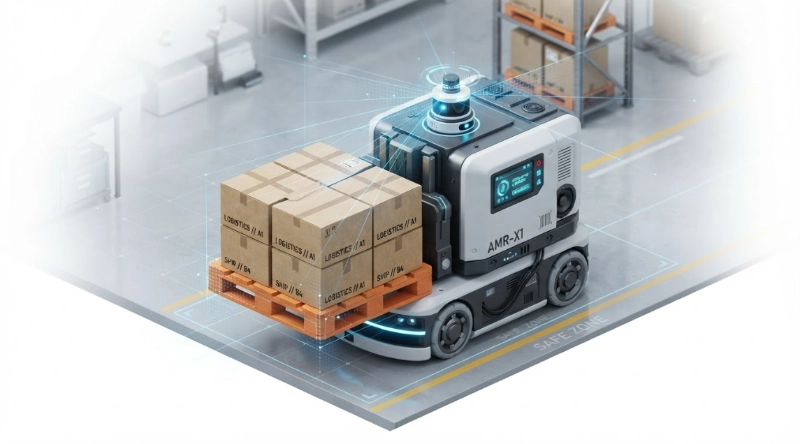
1. Continuous Operation and High Duty Cycles
Unlike consumer electronics that are used intermittently or electric vehicles that spend most of their time parked, industrial robots are designed to work. In modern logistics facilities, robots operate on 24/7 schedules. They are expected to perform continuously, only pausing for brief charging intervals. This requires energy storage capable of handling deep and frequent charge-discharge cycles without rapid degradation.
2. Variable and Surge Power Profiles
A mobile robot’s power consumption is rarely linear. Moving in a straight line on a smooth warehouse floor requires minimal energy. However, lifting a 1,000-kilogram pallet, accelerating from a standstill, or navigating up an incline draws massive, instantaneous spikes in current. The chosen power source must possess the internal architecture to deliver high discharge rates without suffering from excessive voltage sag or overheating.
3. Additional Computational Loads
Modern AMRs are effectively rolling supercomputers. They rely on LiDAR, stereoscopic cameras, ultrasonic sensors, and continuous Wi-Fi/5G connectivity to navigate safely. The processing power required for real-time Simultaneous Localization and Mapping (SLAM) algorithms drains significant power even when the robot is physically stationary. Therefore, a modern battery for mobile robot applications must account for a high baseload of auxiliary power consumption.
4. Harsh Operating Environments
Robots are deployed in diverse environments. Some operate in cold storage warehouses at sub-zero temperatures, while others work in agricultural settings exposed to extreme heat, humidity, and vibration. The internal chemistry and external casing of the power pack must withstand these environmental extremes while maintaining safety and performance.
Primary Chemistry Types in Modern Robotics
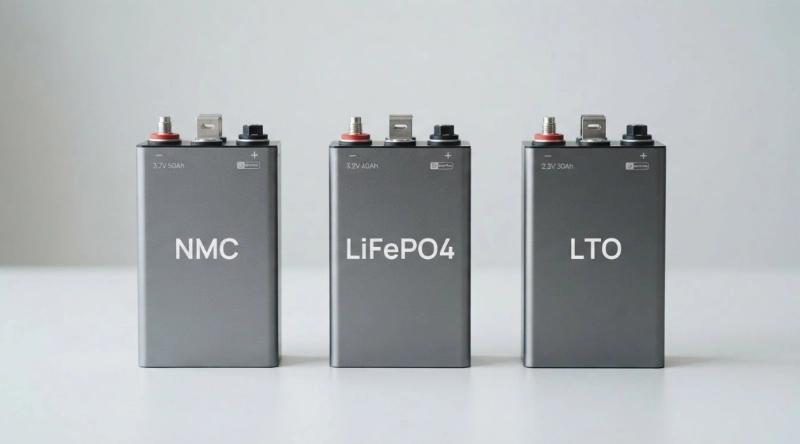
The evolution of battery technology has provided engineers with several viable chemistries, each with distinct advantages and compromises. The transition away from traditional technologies toward advanced lithium-based solutions marks the current era of robotics engineering.
Legacy Solutions: Lead-Acid (AGM and Gel)
Historically, Sealed Lead-Acid (SLA), Absorbed Glass Mat (AGM), and Gel batteries were the standard for early AGVs.
- Pros: They are inexpensive, highly recyclable, and their massive weight was often utilized as a functional counterweight in forklift-style robots.
- Cons: They suffer from terrible energy density (meaning they take up too much space for the energy they provide), slow charging times (often requiring 8-12 hours to fully charge), and a short cycle life. Furthermore, they degrade rapidly if not fully recharged regularly. In the fast-paced modern robotics sector, lead-acid is largely obsolete except for highly specialized, cost-sensitive legacy applications.
The Modern Standard: Lithium-Ion (NMC and NCA)
Lithium Nickel Manganese Cobalt (NMC) and Lithium Nickel Cobalt Aluminum (NCA) represent the most energy-dense commercial batteries available today.
- Pros: Exceptional energy density and specific energy. They are lightweight, allowing robots to carry heavier payloads instead of dragging heavy power packs.
- Cons: They have a relatively shorter cycle life compared to other lithium variants (typically 1,000 to 2,000 cycles). Additionally, their thermal stability is lower, requiring sophisticated management to prevent thermal runaway. They are often the preferred choice for aerial drones and lightweight delivery bots where every gram of weight matters.
The Industrial Workhorse: Lithium Iron Phosphate (LiFePO4 / LFP)
For heavy-duty and continuous-use robotics, LiFePO4 has become the undisputed chemistry of choice.
- Pros: Outstanding cycle life (often exceeding 4,000 to 6,000 cycles at deep depths of discharge), remarkable thermal stability, and intrinsic safety. LFP batteries are virtually immune to thermal runaway and fire, even if punctured or overcharged.
- Cons: Lower energy density than NMC, meaning the packs are slightly larger and heavier for the same capacity. However, in terrestrial warehouse robots, this slight weight penalty is entirely negligible compared to the massive gains in lifespan and safety.
The Fast-Charging Specialist: Lithium Titanate (LTO)
- Pros: LTO batteries allow for ultra-fast charging (sometimes fully charging in under 15 minutes) and boast an extraordinary cycle life of 10,000 to 20,000 cycles. They also perform exceptionally well in sub-zero temperatures.
- Cons: They have the lowest energy density of the lithium family and are significantly more expensive. They are utilized in highly specialized environments where continuous “opportunity charging” allows the robot to run indefinitely with only brief stops.
Chemistry Comparison Table
| Chemistry Type | Energy Density (Wh/kg) | Typical Cycle Life | Fast Charging Capability | Safety / Thermal Stability | Best Robotics Use Case |
|---|---|---|---|---|---|
| Lead-Acid (AGM/Gel) | 30 – 50 | 300 – 500 | Poor | High | Legacy guided vehicles, static lifts |
| Lithium-Ion (NMC) | 150 – 250 | 1,000 – 2,000 | Good | Moderate | Aerial drones, lightweight delivery |
| LiFePO4 (LFP) | 90 – 130 | 3,000 – 6,000+ | Very Good | Very High | Heavy-duty AMRs, warehouse logistics |
| Lithium Titanate (LTO) | 50 – 80 | 10,000 – 20,000 | Excellent | Extremely High | Cold storage, 24/7 continuous operation |
Key Specifications and Electrical Parameters
When configuring the ideal power source, engineers must calculate precise electrical parameters to match the kinematic and computational requirements of the robot.
Voltage and Capacity (Ah)
The system voltage (typically 12V, 24V, 48V, or increasingly 72V+) dictates the efficiency of the motors. Higher voltage systems allow for thinner wiring, lower resistive heat losses, and more efficient motor control, which is why industrial AMRs are standardizing on 48-volt architectures. Capacity, measured in Ampere-hours (Ah), determines the total energy reservoir.
Discharge Rates (C-Rating)
The C-rating is arguably the most critical metric for mechanical movement. It defines the maximum current a battery can safely discharge relative to its capacity. If an AMR encounters a steep ramp while carrying maximum payload, it will draw a surge current. If the battery’s C-rating is too low, the voltage will collapse, triggering a system shutdown or damaging the internal cells. Selecting a pack with an appropriate continuous and peak discharge rate ensures smooth mechanical operations under high strain.
Depth of Discharge (DoD)
Unlike lead-acid units that suffer permanent damage if discharged below 50%, modern lithium solutions can be deeply discharged (often down to 10% or 20% State of Charge) without significant penalty. Understanding the acceptable DoD helps fleet managers program the robot’s logic regarding when it must abandon its tasks and return to the charging dock.
The Critical Role of Battery Management Systems (BMS)
Lithium batteries cannot operate in a vacuum; they require a highly intelligent brain to govern their behavior. The Battery Management System (BMS) is the electronic gatekeeper that ensures the safety, longevity, and performance of the pack. An advanced BMS provides several critical functions:
- Cell Balancing: Over time, individual cells within a large pack can become imbalanced in voltage. The BMS shunts energy between cells during charging, ensuring all cells reach maximum capacity simultaneously, thereby extending the pack’s overall lifespan.
- Thermal Management: The BMS monitors temperature via embedded thermistors. If the pack gets too hot during heavy lifting or fast charging, the BMS can throttle the current or activate active cooling systems.
- Safety Protections: It instantly physically disconnects the battery from the robot in the event of over-voltage (during charging), under-voltage (over-discharging), short circuits, or extreme temperature anomalies.
- Communication Protocols: A modern intelligent pack does not just provide power; it provides data. Through CAN bus, RS485, or Ethernet protocols, the BMS communicates with the robot’s main controller. It transmits real-time State of Charge (SoC) and State of Health (SoH), allowing the fleet management software to optimize task assignments and route the robot to charging stations autonomously.
Charging Strategies and Infrastructure Integration
Designing a holistic robotics power solution requires looking beyond the vehicle itself and analyzing the charging infrastructure. The workflow of the facility dictates the charging strategy.
Opportunity Charging
This is the most popular strategy in modern 24/7 facilities. Instead of waiting for the battery to drain to 10% and then charging for hours, the robot utilizes idle time to top up its charge. If the robot has a 5-minute wait while a conveyor belt loads a pallet onto it, it docks with a nearby charging station and receives a high-current burst of energy. This keeps the SoC consistently between 40% and 80%, which is the ideal range for maximizing lithium cell longevity.
Battery Swapping
For operations that cannot afford even brief charging downtimes, battery swapping systems are employed. When a robot runs low, it approaches a swapping station where an automated mechanism extracts the depleted pack and inserts a fully charged one in under two minutes. While this maximizes robot uptime, it requires purchasing extra battery packs and investing in complex mechanical swapping infrastructure.
Wireless / Inductive Charging
Emerging strongly in the medical and clean-room manufacturing sectors, inductive charging removes the need for exposed physical contact pads. The robot positions itself over a charging mat, and energy is transferred via electromagnetic fields. While slightly less efficient than contact charging, it eliminates mechanical wear and the risk of electrical arcing, making it ideal for environments requiring strict sterility or dealing with heavy dust.
Total Cost of Ownership (TCO) and Environmental ROI
When procurement departments evaluate the cost of a robot battery, focusing solely on the upfront capital expenditure (CAPEX) is a critical error. The true metric is the Total Cost of Ownership (TCO).
A lead-acid pack might cost one-third of the price of a sophisticated LiFePO4 pack. However, over a 5-year operational period, the lead-acid pack will likely need to be replaced three to four times. Furthermore, the 8-hour charging times of lead-acid mean the facility must purchase more robots to achieve the same throughput as a fleet utilizing fast-charging lithium solutions.
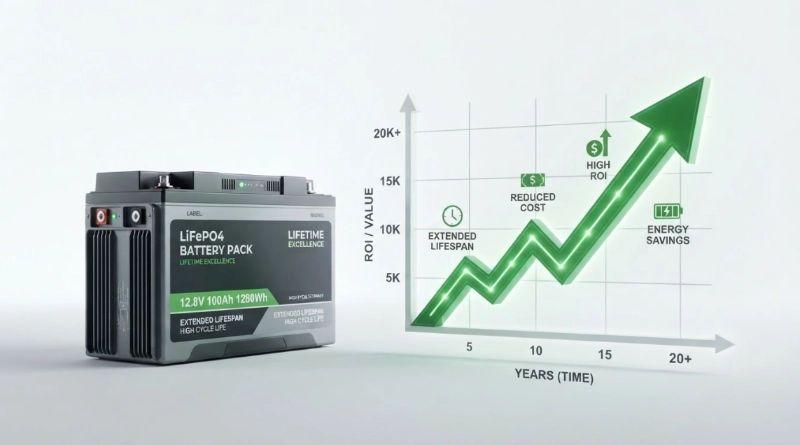
When factoring in replacement costs, maintenance labor (watering lead-acid batteries), charging efficiency, and increased robotic uptime, lithium-based chemistries present a drastically lower TCO. Furthermore, longer-lasting batteries reduce industrial waste, contributing to corporate sustainability and ESG (Environmental, Social, and Governance) goals.
Conclusion
The convergence of artificial intelligence, advanced sensors, and mobility has created robotic systems capable of extraordinary feats. However, the beating heart of these autonomous systems remains their energy storage. Choosing the correct battery architecture involves a delicate balance of energy density, discharge capabilities, thermal safety, and intelligent management. By prioritizing advanced chemistries like LiFePO4, integrating robust BMS communications, and aligning the battery choice with smart charging strategies, engineers can ensure their automated fleets operate at peak efficiency, yielding maximum productivity and long-term profitability.
FAQs
Q1: How long should an AMR battery realistically last before needing a replacement?
A: The lifespan depends heavily on the chemistry and duty cycle. A high-quality LiFePO4 (Lithium Iron Phosphate) pack managed by an advanced BMS typically lasts between 3,000 to 6,000 cycles. For a robot operating 24/7 and charging once or twice a day, this translates to roughly 5 to 8 years of operational life before the battery degrades to 80% of its original capacity.
Q2: Can we upgrade our older fleet of lead-acid AGVs with modern lithium technology?
A: Yes, many manufacturers offer “drop-in” lithium replacement packs. However, because lithium batteries charge much faster and have different voltage discharge curves, you must ensure that your existing charging infrastructure is compatible. Additionally, because lithium is much lighter, robots that rely on the heavy weight of lead-acid batteries for counter-balancing may require the addition of steel ballast weights.
Q3: Does extreme cold temperature affect warehouse robot batteries?
A: Absolutely. In cold storage environments (e.g., -20°C), standard lithium-ion batteries suffer from increased internal resistance, leading to reduced capacity and the inability to accept fast charges without risking “lithium plating” damage. For cold storage, batteries require built-in internal heating mats managed by the BMS, or specialized chemistries like Lithium Titanate (LTO) which naturally perform better in sub-zero conditions.