









What is the Difference Between Standard Lithium and LiFePO4 Batteries
Release time: 2026-08-03
Índice
In the rapidly evolving landscape of renewable energy, electric mobility, and portable electronics, energy storage is the critical bottleneck and the ultimate enabler. As consumers and engineers alike look to power their next big project, they are often confronted with a confusing array of battery terminologies. Among the most frequently asked questions in the energy storage industry today is: What exactly is the difference between standard lithium batteries and lithium iron phosphate (LiFePO4) batteries?
At first glance, the terminology can be deceiving. Many buyers assume these are two completely unrelated technologies competing for the same market share. However, making an informed decision requires looking past the marketing jargon and understanding the underlying electrochemistry, performance metrics, and long-term economic impacts of these power solutions.
This comprehensive guide will break down the relationship between these technologies, compare their energy densities, evaluate their safety profiles, analyze their true costs, and help you determine which battery chemistry is the perfect fit for your specific application. Furthermore, we will look ahead to see how current limitations are driving the industry toward the next frontier: tecnologia de estado sólido.
1. Clarifying the Relationship: The “Lithium” Umbrella and the LiFePO4 Subcategory
The most crucial step in understanding the difference between these two terms is realizing that you are not comparing apples to oranges; rather, you are comparing fruit to a specific type of apple.
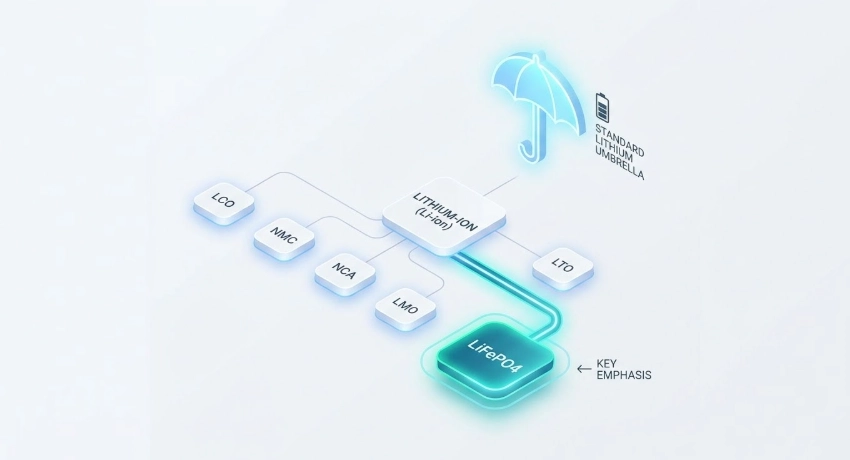
“Lithium-ion battery” (often abbreviated simply as “lithium battery”) is a broad, overarching category. It refers to any rechargeable battery in which lithium ions move from the negative electrode (anode) to the positive electrode (cathode) during discharge and back when charging.
Underneath this broad umbrella, there are several distinct chemical compositions, usually named after the materials used in their cathodes. The most common “standard” lithium-ion batteries include:
- Lithium Cobalt Oxide (LCO): Widely used in smartphones and laptops.
- Lithium Nickel Manganese Cobalt Oxide (NMC): The standard for most electric vehicles (EVs) and electric power tools.
- Lithium Nickel Cobalt Aluminum Oxide (NCA): Famously used in high-performance EVs.
Lithium Iron Phosphate (LiFePO4 or LFP), on the other hand, is a specific subcategory within the lithium-ion family. Instead of using cobalt, nickel, or manganese, it utilizes iron phosphate as the cathode material. Therefore, every LiFePO4 battery is technically a lithium battery, but not all lithium batteries are LiFePO4.
When the industry colloquially pits “Lithium vs LiFePO4,” they are generally comparing traditional cobalt-based lithium-ion batteries (like NMC or LCO) against the newer, iron-phosphate-based alternatives.
2. Energy Density Differences: Lightweight Agility vs. Bulky Stability
Energy density is arguably the most critical metric for portable power. It dictates how much energy a battery can store relative to its physical weight (gravimetric density, measured in Wh/kg) and its physical size (volumetric density, measured in Wh/L).
Standard Lithium-Ion (NMC/LCO): The Champion of Lightweight Power Standard cobalt-based lithium batteries boast exceptional energy density. Modern NMC batteries can achieve energy densities ranging from 150 to over 250 Wh/kg. This high concentration of energy means you can pack a massive amount of power into a very small, lightweight package. This is why cell phones can remain incredibly thin and why high-performance electric cars can accelerate rapidly without carrying thousands of extra pounds of battery weight. If your application demands the absolute lowest weight and smallest footprint, standard lithium-ion remains unmatched.
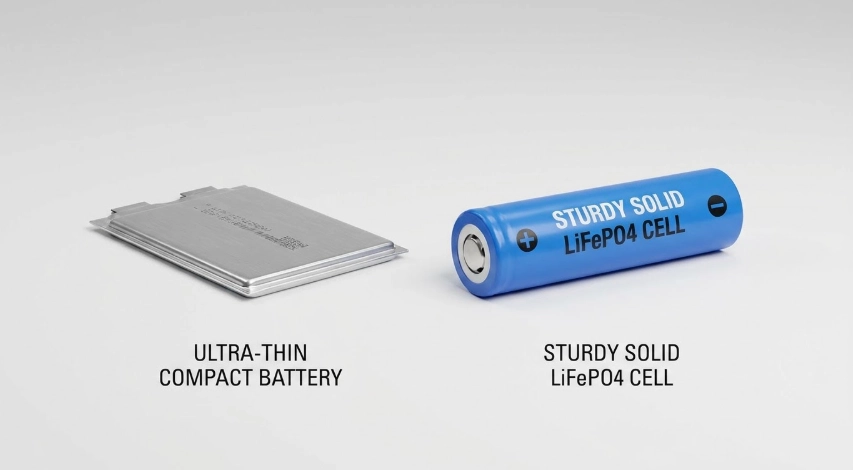
LiFePO4: Prioritizing Stability Over Compactness LiFePO4 energy density is noticeably lower, typically hovering between 90 and 160 Wh/kg. To store the exact same amount of energy as an NMC battery, an LFP battery pack will need to be physically larger and heavier. Historically, this made LFP unsuitable for applications like smartphones or aerospace engineering. However, what LFP sacrifices in raw energy density, it makes up for in remarkable electrochemical stability. The iron and phosphate materials are inherently robust, meaning the battery cells do not degrade as quickly under stress, allowing for a heavier but vastly more durable energy storage solution.
3. Safety First: High Temperatures, Overcharging, and Thermal Stability
When dealing with high-capacity energy storage, safety is paramount. The differences in chemical structures between these two battery types result in vastly different safety profiles.
The Thermal Runaway Risk in Standard Lithium
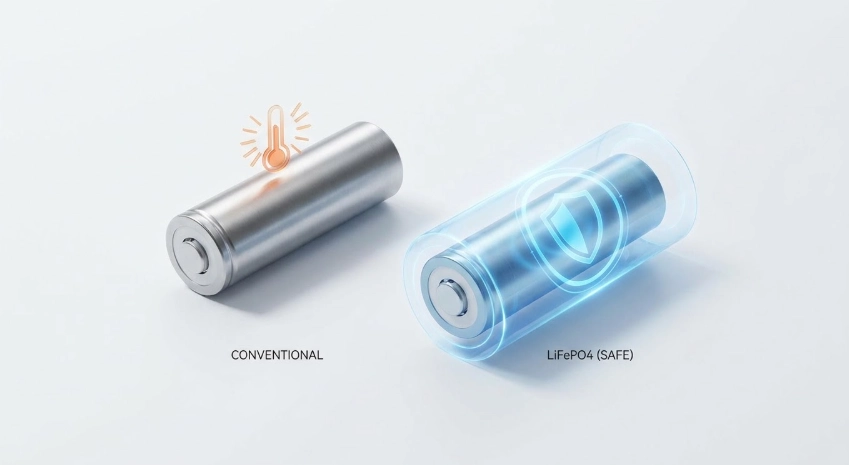
Standard lithium-ion batteries (especially LCO and NMC) are highly reactive. The chemical bonds holding the oxygen in the cobalt or nickel oxides are relatively weak. If the battery is damaged, short-circuited, heavily overcharged, or exposed to extreme heat (usually above 150°C or 300°F), these bonds break down. This releases oxygen internally, which feeds the heat-generating chemical reaction in a dangerous feedback loop known as battery thermal runaway. This is the phenomenon responsible for the highly publicized laptop, hoverboard, and EV battery fires, which are notoriously difficult to extinguish.
The Inherent Safety of LiFePO4
This is where LFP truly shines. The phosphorus-oxygen (P-O) covalent bond in the lithium iron phosphate cathode is incredibly strong. Even under extreme conditions—such as severe overcharging, physical puncture, or exposure to high temperatures—the structure remains stable. LFP cells will not release oxygen and typically will not experience thermal runaway until temperatures exceed 270°C (518°F). Even if they do fail, they tend to merely smoke rather than catch fire or explode. For applications where safety cannot be compromised, LFP is the undisputed leader.
Comprehensive Comparison Matrix
| Feature / Specification | Standard Lithium-Ion (NMC/LCO) | Lithium Iron Phosphate (LiFePO4) |
|---|---|---|
| Cathode Material | Cobalt, Nickel, Manganese | Iron, Phosphate |
| Densidade de energia | High (150 – 250+ Wh/kg) | Moderate (90 – 160 Wh/kg) |
| Perfil de segurança | Moderate risk of thermal runaway | Extremely safe, highly stable |
| Temperatura de fuga térmica | ~150°C (300°F) | ~270°C (518°F) |
| Typical Cycle Life | 500 – 2,000 cycles | 3,000 – 6,000+ cycles |
| Environmental Impact | High (Cobalt/Nickel mining issues) | Low (Non-toxic, abundant materials) |
| Upfront Cost | Generally higher per kWh | Lower to moderate per kWh |
4. Lifespan and True Cost: Upfront Price vs. Long-Term Value
Cost and lifespan are inextricably linked in the world of batteries. To evaluate them properly, one must look beyond the initial purchase price and calculate the total cost of ownership for batteries over their entire operational life.
Cycle Life: The Marathon Runner vs. The Sprinter
A “cycle” is defined as discharging a battery and then fully recharging it. Standard lithium-ion batteries typically offer a lifespan of 500 to 2,000 cycles before their capacity degrades to 80% of its original state. In a smartphone charged daily, this equates to roughly 2 to 3 years of optimal use.
LiFePO4 batteries are the marathon runners of the energy world. A standard LFP cell can easily achieve 3,000 to over 6,000 cycles with minimal degradation. In a residential solar setup cycled once a day, an LFP battery could theoretically last 10 to 15 years before seeing a noticeable drop in performance. Furthermore, LFP batteries handle deep discharges (100% Depth of Discharge) far better than NMC batteries, which prefer shallow cycling.
Cost Analysis
Historically, NMC batteries were cheaper to manufacture due to massive economies of scale in the consumer electronics sector. However, the narrative has shifted. Standard lithium relies heavily on cobalt and nickel—minerals that are expensive, subject to severe supply chain volatility, and associated with ethical mining concerns.
LiFePO4 uses iron and phosphate, which are abundant, inexpensive, and non-toxic. Today, the upfront manufacturing cost per kilowatt-hour (kWh) for LFP is often lower than NMC. More importantly, because LFP lasts three to four times longer, the cost per cycle (the true metric of battery economics) is drastically lower.
5. Ideal Scenarios: Matching Chemistry to Application
Because of their distinct characteristics, standard lithium-ion and LFP batteries dominate different sectors of the market.
Where Standard Lithium (NMC/LCO) Excels:
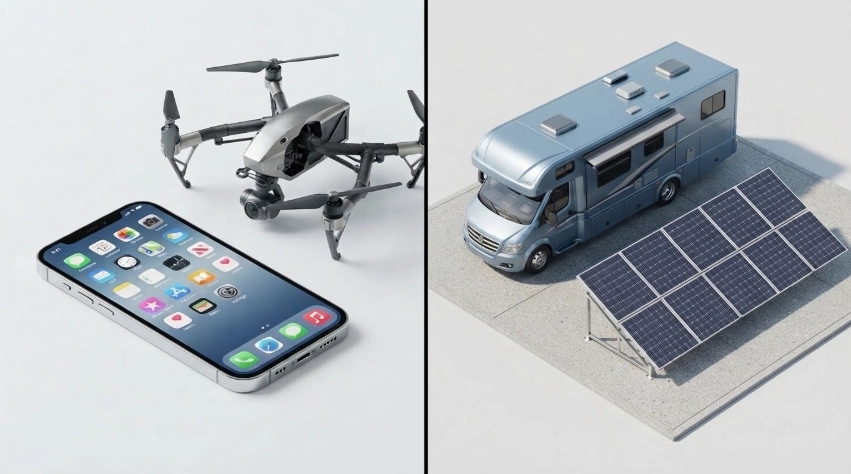
- Eletrônicos de consumo: Smartphones, tablets, laptops, and smartwatches where space is strictly limited and weight matters.
- Drones and RC Vehicles: Applications requiring maximum burst power and minimal weight to maintain flight times.
- High-Performance EVs: Sports cars and luxury electric vehicles that require extended range and rapid acceleration but have limited physical chassis space.
Where LiFePO4 (LFP) Dominates:
- Solar and Off-Grid Storage: Residential and commercial energy storage where weight is irrelevant, but longevity, safety, and cycle life are critical.
- Recreational Vehicles (RVs) and Marine: House batteries for boats and campers where the battery will be deeply discharged regularly and subjected to harsh physical vibrations.
- Standard Range EVs and Fleet Vehicles: Electric buses, delivery vans, and entry-level EVs. The extra weight is acceptable in exchange for a battery that outlasts the vehicle’s chassis and poses zero fire risk in a crash.
- Industrial Applications: Forklifts, golf carts, and heavy machinery operating in demanding environments.
6. What Users Overlook When Choosing a Battery System
When consumers and engineers select a battery system, they often focus entirely on capacity (Ah or kWh) and the sticker price. However, several critical factors are frequently overlooked, leading to poor system performance.
1. Cold Weather Charging Limitations While both batteries perform well in warm conditions, LFP batteries have a distinct vulnerability: they cannot be charged at temperatures below freezing (0°C or 32°F) without causing irreversible damage (lithium plating). If you are installing an LFP battery in an unheated RV or an outdoor shed in a cold climate, you must purchase a model with a built-in self-heating function or ensure the Battery Management System (BMS) has low-temperature charging protection.
2. Battery Management System (BMS) Quality A battery is only as good as its brain. The BMS protects against overcharging, over-discharging, and temperature extremes. Because LFP has a very flat discharge voltage curve (meaning the voltage stays almost the same until the battery is nearly dead), a cheap BMS will struggle to accurately read the remaining battery percentage. Investing in a high-quality, smart BMS is crucial for LFP setups.
3. Volumetric Constraints As noted, LFP is bulkier. Buyers often purchase LFP as a drop-in replacement for lead-acid or standard lithium without measuring their battery compartment. Always verify the physical dimensions, as a 100Ah LFP battery will take up more space than a 100Ah NMC battery.
7. The Future: A Natural Transition to Solid-State Batteries
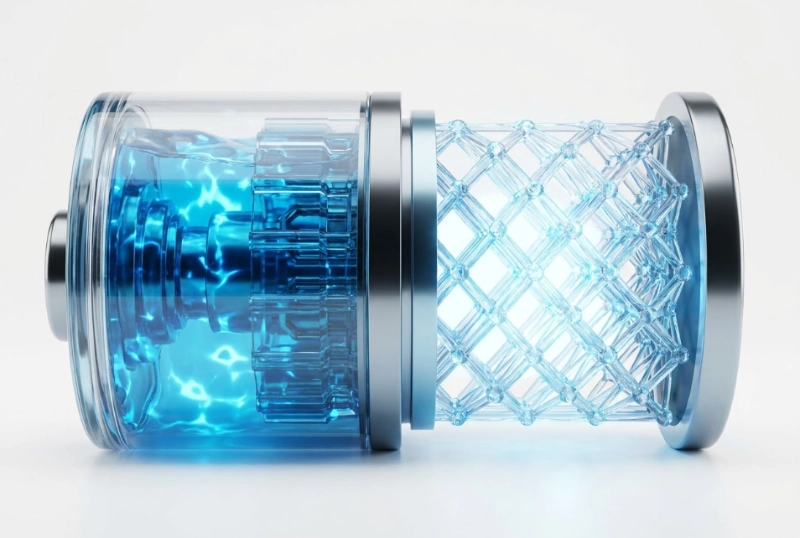
While NMC offers energy density and LFP offers safety and longevity, the industry is constantly searching for the “holy grail” that provides all three. This is driving the rapid development of solid-state battery transition.
Current lithium-ion and LFP batteries use a liquid electrolyte to facilitate the movement of ions between the cathode and anode. This liquid is flammable and limits how densely the battery materials can be packed.
baterias de estado sólido replace this liquid with a solid, non-flammable electrolyte (such as ceramics, glass, or solid polymers). This transition promises to be revolutionary. Solid-state technology will allow for energy densities far exceeding current NMC batteries, while simultaneously offering safety profiles that rival or beat LFP batteries, as there is no flammable liquid to catch fire. As the demands of long-haul electric trucking, electric aviation, and grid-scale storage increase, both standard lithium and LFP will eventually serve as stepping stones to a solid-state future.
Perguntas frequentes
Can I use a LiFePO4 battery as a direct drop-in replacement for my old lead-acid or standard lithium-ion battery?
In many 12V systems (like RVs or boats), a LiFePO4 battery can replace a lead-acid battery, but it is not a simple “plug-and-play” scenario. You must ensure that your existing charger or solar charge controller is compatible with lithium profiles. LFP batteries have different charging voltage requirements than lead-acid or standard lithium. Using an incorrect charger can trigger the battery’s BMS to shut down or fail to charge the battery fully.
Which battery type is better suited for extreme outdoor weather conditions?
For extreme heat, LiFePO4 is the absolute winner due to its incredible thermal stability; it can operate safely in environments where standard lithium might risk thermal runaway. However, for extreme cold, standard lithium-ion (NMC) generally performs slightly better. Standard lithium can accept a charge at slightly lower temperatures than LFP. If you use LFP in freezing environments, you must ensure the battery is equipped with internal heating pads.
If LiFePO4 is a newer and “better” technology, why is it heavier than standard lithium batteries?
“Better” is subjective depending on the application. LFP is superior in safety and cycle life, but it is chemically less energy-dense. The molecular structure of iron and phosphate simply weighs more and occupies more physical volume to store the same amount of electrons as the cobalt and nickel oxides used in standard lithium batteries. Therefore, standard lithium remains the better choice for weight-sensitive applications like cell phones and drones.