









แบตเตอรี่โซลิดสเตทสำหรับอุปกรณ์ทางการแพทย์ – โซลูชันด้านพลังงานสำหรับอุตสาหกรรมการดูแลสุขภาพ
Release time: 2026-07-03
สารบัญ
The medical technology landscape is undergoing a silent yet rapid revolution. From ultra-discreet continuous glucose monitors (CGMs) to life-saving deep brain stimulators and implantable cardioverter-defibrillators (ICDs), modern medicine is increasingly reliant on micro-electronics. However, as medical devices shrink in size while growing in computational complexity, they face a fundamental physical bottleneck: electrochemical power storage.
For decades, liquid-electrolyte lithium-ion chemistries have been the gold standard for clinical electronics. Despite their utility, these conventional systems carry inherent risks of chemical leakage, high degradation rates, and catastrophic thermal runaway. In the uncompromising realm of healthcare—where a power failure can have direct clinical consequences—a safer, more energy-dense, and highly stable power architecture is urgently needed. This is precisely where the development of a dedicated แบตเตอรี่โซลิดสเตทสำหรับอุปกรณ์ทางการแพทย์ represents a monumental leap forward. By replacing volatile liquid chemistries with solid ion conductors, this next-generation power technology is poised to redefine patient care and unlock unprecedented design possibilities for medical hardware engineers.
Why Solid-State Physics Outperforms Liquid Chemistry
To understand the transformative potential of solid-state technology in clinical applications, one must look at the interface level. Traditional lithium-ion batteries rely on an organic liquid solvent (such as ethylene carbonate) containing dissolved lithium salts to transport ions between the anode and the cathode. While highly conductive, this liquid is highly flammable and requires bulky physical separators to prevent short circuits. Furthermore, liquid electrolytes are highly reactive with pure lithium-metal anodes, leading to the formation of microscopic, needle-like structures called dendrites that can pierce separators and cause instant failure.
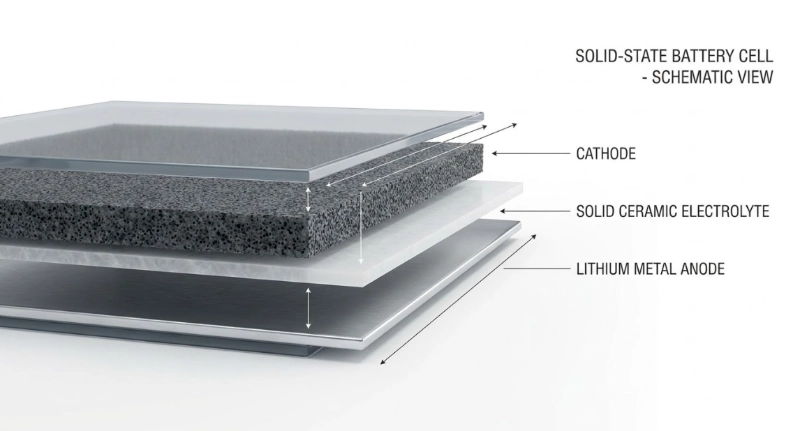
Solid-state cells completely reimagine this architecture by replacing the liquid with a solid-state electrolyte (SSE). This solid barrier acts simultaneously as the separator and the ion transport medium, offering several immediate physical advantages:
- Suppression of Dendritic Growth: High mechanical strength solid electrolytes (such as ceramic oxides or dense polymers) physically obstruct the growth of lithium dendrites, allowing the safe integration of pure lithium-metal anodes.
- Expanded Electrochemical Window: Solid electrolytes are chemically stable at higher voltages, enabling the use of high-voltage cathode materials that significantly elevate energy densities.
- Elimination of Phase Transitions: Because there is no liquid to vaporize, freeze, or leak, these cells operate across extreme temperature ranges without risk of physical expansion or structural bursting.
This structural evolution transforms the humble แบตเตอรี่โซลิดสเตท from a theoretical laboratory concept into an ultra-reliable, high-performance engine for advanced therapeutics.
Major Classes of Solid Electrolytes for MedTech
Not all solid-state architectures are created equal. The medical device industry primarily focuses on three major material groups, each offering distinct mechanical and electrical properties tailored to specific clinical requirements:
- อิเล็กโทรไลต์ชนิดออกไซด์: These ceramic materials boast exceptional chemical stability, high safety margins, and absolute non-flammability. They are highly resistant to moisture and environmental degradation, making them ideal for long-term hermetically sealed implants.
- อิเล็กโทรไลต์ชนิดซัลไฟด์: Renowned for their superb room-temperature ionic conductivity (sometimes surpassing liquid equivalents), sulfides are softer and easier to process via roll-to-roll manufacturing. However, they require careful encapsulation to prevent the formation of toxic hydrogen sulfide gas if exposed to moisture.
- อิเล็กโทรไลต์ชนิดโพลีเมอร์: Flexible and lightweight, polymer matrices are highly customizable and cost-effective. While they traditionally required elevated operating temperatures to achieve adequate ionic conductivity, modern composite polymers are bridging the gap for low-power wearable devices.
Comparing Energy Technologies for Modern Healthcare
Selecting the right electrochemical energy storage system involves a careful balance of volumetric energy density, cycle life, safety profiles, and cost. The table below provides a quantitative comparison of how solid-state systems stand against conventional medical power chemistries:
| ตัวชี้วัดประสิทธิภาพ | Conventional Liquid Li-Ion | Thin-Film Solid-State | Bulk Solid-State | Lithium Primary (Non-Rechargeable) |
|---|---|---|---|---|
| ความหนาแน่นพลังงานเชิงปริมาตร | 500–700 Wh/L | 300–900 Wh/L | 800–1,200 Wh/L | 400–600 Wh/L |
| Gravimetric Energy Density | 150–260 Wh/kg | 150–300 Wh/kg | 350–500 Wh/kg | 200–300 Wh/kg |
| Typical Cycle Life (at 80% DoD) | 300–1,000 cycles | 5,000–100,000+ cycles | 2,000–10,000 cycles | N/A (Single use) |
| Self-Discharge Rate (per Year) | 5% – 10% | < 1% (Ultra-low leakage) | < 2% | < 1% |
| ข้อมูลด้านความปลอดภัย | Moderate (Risk of thermal runaway & leakage) | Extremely High (Non-flammable, solid chemistry) | Extremely High (Highly stable, robust structure) | High (But limited by chemical stability) |
| ช่วงอุณหภูมิการทำงาน | -20℃ to 60℃ | -40℃ to 120℃ | -30℃ to 100℃ | -40℃ to 85℃ |
| Primary Form Factors | Cylindrical, Prismatic, Pouch | Micro-scale, Ultra-thin, On-chip | Customizable, Prismatic, Pouch | Coin cell, Cylindrical |
By examining the data, it becomes clear why the แบตเตอรี่โซลิดสเตท is considered the holy grail of modern medical power. The leap in volumetric energy density means devices can either be made up to 50% smaller while maintaining their current battery life, or keep their current dimensions while doubling their clinical runtime.
Clinical Benefits of Solid-State Integration
Implementing solid-state power systems translates directly into real-world clinical and patient advantages. Let us dissect the core value propositions:
Absolute Patient Safety and Non-Toxicity
With liquid lithium-ion cells, any physical puncture, internal short-circuit, or manufacturing defect can cause a thermal runaway event. In this scenario, the organic liquid electrolyte heats up, vaporizes, catches fire, and can explode. For a patient with an implant near their heart or brain, this is a catastrophic risk. Solid-state architectures eliminate this failure mechanism entirely. Ceramic and glass-based solid electrolytes are inherently non-combustible. If a solid-state cell is physically damaged, pierced, or crushed, there is no flammable liquid to ignite and no corrosive fluid to leak into surrounding biological tissue.
Extreme Miniaturization and Mechanical Design Flexibility
Because solid-state cells do not require heavy, rigid protective casings to contain internal pressure or prevent liquid leakage, their packaging can be incredibly minimalist. Thin-film solid-state cells can be printed directly onto silicon substrates or integrated into flexible polymer backings. This opens up new possibilities for conformal and flexible geometries, allowing power sources to bend smoothly around structural enclosures or adhere comfortably to the natural curves of human anatomy.
Decades-Long Operational Lifespans
Replacing an implantable medical device solely because its battery has degraded is a highly invasive, costly, and risky surgical procedure. Traditional rechargeable lithium cells lose a significant portion of their capacity after just a few years of daily charge-discharge cycles. In contrast, thin-film solid-state cells can withstand tens of thousands of cycles with minimal capacity loss. Combined with an incredibly low self-discharge rate (often less than 1% annually), these cells can comfortably operate inside the human body for up to 15 to 20 years, dramatically reducing the frequency of replacement surgeries.
Key Medical Applications and Case Studies
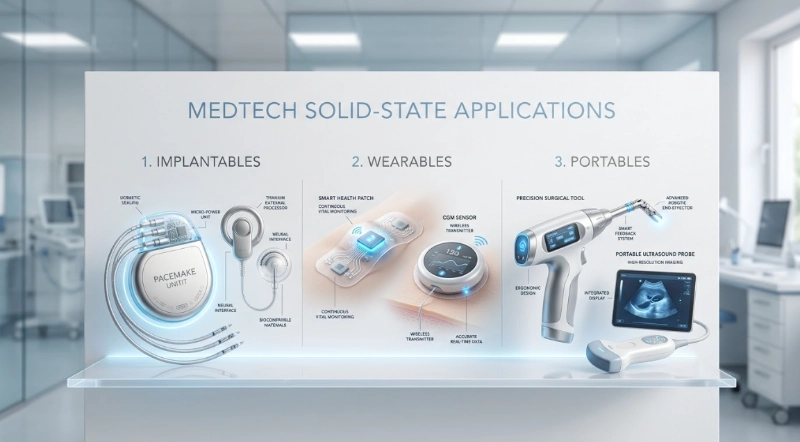
The clinical utility of solid-state power spans the entire spectrum of modern healthcare, from active implantable medical devices (AIMDs) to connected health wearables.
Active Implantable Medical Devices (AIMDs)
Historically, implantable stimulators had to rely on primary (non-rechargeable) chemistry or highly secure, bulky liquid-based lithium-ion cells. The volume of the battery accounted for up to 80% of the entire device footprint. Therefore, integrating a next-generation แบตเตอรี่โซลิดสเตทสำหรับอุปกรณ์ทางการแพทย์ solves the classic trade-off between device size and operational longevity.
- Neuromodulation: Micro-stimulators targeting the vagus nerve or deep brain structures can be engineered down to the millimeter scale, enabling minimally invasive outpatient implantation procedures.
- Cochlear Implants: Patients can benefit from fully implantable cochlear systems that are completely invisible from the outside, charging wirelessly via a sleek headpiece during sleep.
Smart Patches and Diagnostic Wearables
Wearable clinical sensors are revolutionizing patient monitoring by transitioning healthcare from reactive hospital visits to proactive, continuous at-home monitoring. Whether it is a smart insulin pump worn on the belt or a handheld diagnostic scanner used in rural clinics, the demand for a highly reliable แบตเตอรี่ทางการแพทย์แบบพกพา has never been higher. By employing solid electrolytes, manufacturers can construct a portable medical battery that is not only significantly lighter but also structurally robust enough to withstand being dropped or exposed to bodily fluids. Smart skin patches utilizing thin-film solid-state chemistry can be worn during high-impact sports, showering, or sleep without any discomfort, transmitting real-time heart rate, blood oxygen, or interstitial glucose levels directly to clinical monitoring platforms.
Regulatory Hurdles and Quality Assurance Standards
Developing energy storage solutions for the medical market involves navigating a highly complex web of international regulations. Unlike consumer electronics, where minor performance deviations are acceptable, medical hardware must operate with absolute predictability.

Biocompatibility and ISO 10993 Compliance
To achieve this status, a true แบตเตอรี่เกรดทางการแพทย์ must undergo exhaustive biological safety testing to ensure that even under catastrophic physical damage, it will not harm the patient. ISO 10993 outlines the global standards for evaluating the biological effects of medical devices, covering cytotoxicity, sensitization, systemic toxicity, and genotoxicity.
Designing a แบตเตอรี่เกรดทางการแพทย์ using solid electrolytes drastically simplifies these compliance hurdles by completely removing volatile organic compounds from the cell architecture. If the protective outer casing of an implant is compromised, a ceramic solid electrolyte remains stable in body fluids and does not release hazardous hydrofluoric acid or highly alkaline compounds, ensuring patient safety under worst-case structural failures.
Quality Management and Cleanroom Production (ISO 13485)
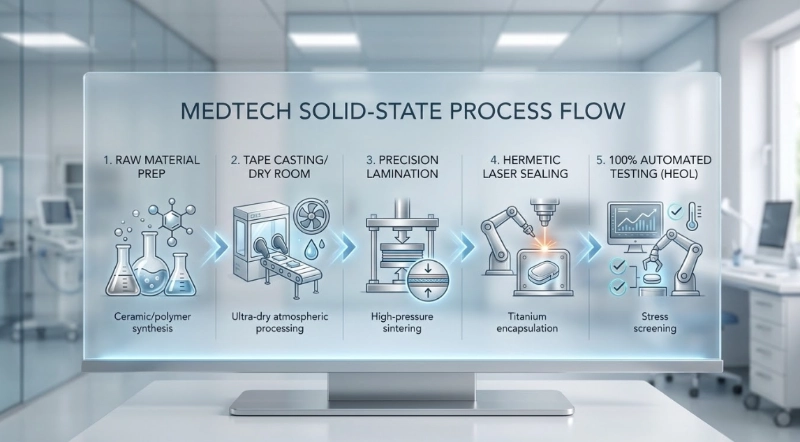
Producing solid-state cells for the medical sector requires strict adherence to ISO 13485 (Medical Devices — Quality Management Systems). The manufacturing environment must be monitored for particulate contamination, temperature variations, and extreme humidity levels. Since solid-state ceramic separators can be highly sensitive to ambient moisture during the assembly phase, state-of-the-art dry rooms with dew points below -50℃ are essential to prevent microscopic defects that could lead to premature cell degradation.
Overcoming Engineering Challenges
While the benefits of solid-state chemistry are undeniable, widespread commercialization within the medical sector requires solving several persistent engineering and manufacturing bottlenecks:
Interfacial Impedance and Contact Resistance
Because solid-solid interfaces are inherently less intimate than solid-liquid interfaces, facilitating smooth lithium-ion transport across the boundary between the solid electrolyte and the solid electrodes is a significant challenge. If a microscopic gap opens due to volumetric expansion or contraction during charging, the battery’s internal resistance surges, leading to drastic performance drops. Engineers are tackling this by applying nanometer-thin buffer layers of atomic layer deposition (ALD) coatings or utilizing semi-solid hybrid gel interfaces that offer the safety of solids with the superior contact characteristics of liquids.
High-Pressure Cycling Requirements
Many bulk solid-state chemistries require continuous external physical pressure (typically between 1 to 5 MPa) to maintain tight physical contact between the active materials and prevent the formation of structural voids. Designing micro-encapsulations or internal mechanical tensioning mechanisms that can deliver this pressure without adding excessive volume or weight is a major focus of ongoing mechanical R&D.
Scaling Up Production Infrastructure
Traditional gigafactories are optimized for liquid-based roll-to-roll slitting, winding, and electrolyte filling. Transitioning to solid-state manufacturing requires completely new production assets, such as high-temperature sintering ovens, physical vapor deposition (PVD) chambers, and specialized dry-room lamination machinery. To bridge this gap, many developers are focusing on “drop-in” solid electrolyte designs that can leverage a substantial portion of existing lithium-ion production lines, helping lower the capital expenditure required for early-market medical products.
The Future of Clinical Power
As we look toward the horizon of healthcare technology, the synergy between solid-state electrochemical systems and medical device design will only grow stronger. The transition from bulky, short-lived diagnostic equipment to invisible, autonomous, and lifelong clinical monitoring systems is fundamentally an energy problem. By unlocking massive gains in safety, volumetric density, and physical adaptability, solid-state cells are removing the power bottleneck entirely.
In the coming decade, we will witness the commercialization of fully biodegradable diagnostic sensors, self-powered micro-implants that harvest thermal or kinetic energy directly from the human body, and smart drug-delivery networks that operate continuously for decades. The medical industry’s shift toward solid-state power is not merely an incremental upgrade; it is a vital catalyst that will bring the next generation of life-saving medical discoveries into reality.
คำถามที่พบบ่อย
How do solid-state batteries differ from traditional lithium-ion batteries in implantable medical devices?
The primary difference lies in the state of the electrolyte. Traditional lithium-ion batteries use a liquid organic solvent to conduct lithium ions, which poses risks of chemical leakage and flammable thermal runaway if damaged. Solid-state designs replace this liquid with a solid ceramic, glass, or polymer material, which acts as both the electrolyte and the separator. This elimination of flammable components makes them intrinsically safe, allows for much higher energy densities, enables flexible and ultra-thin form factors, and delivers an exceptionally long cycle life (often lasting up to 20 years).
What makes a battery “medical grade” and why is compliance so critical?
A battery receives “medical grade” status when it complies with stringent international quality, safety, and performance standards specifically established for clinical environments. Key requirements include ISO 10993 certification (ensuring absolute biocompatibility and non-toxicity to human tissue even if the cell is ruptured) and ISO 13485 compliance (verifying highly controlled, cleanroom-based manufacturing with complete raw-material traceability). Additionally, these cells undergo rigorous testing for hermeticity, resistance to biological fluids, extreme pressure tolerance, and long-term electrical stability to prevent catastrophic failure inside a patient.
Are solid-state batteries already being used in active clinical devices today?
Yes, high-precision micro-scale solid-state batteries (specifically thin-film varieties) are currently active in specialized clinical implants such as neuromodulation devices, vagus nerve stimulators, and small-scale wireless sensors. However, for larger “bulk” power applications like high-capacity external portable diagnostic equipment, the technology is undergoing rapid commercialization and scaling. The industry is currently in a transition phase, with semi-solid-state designs serving as an immediate bridge to all-solid-state systems, which are projected to dominate the premium medical device sector by late 2026 and beyond as production costs continue to decline.