









What You Should Know Before Choosing a Solid-State Battery
Release time: 2026-06-28
Table of Contents
The year 2026 marks a watershed moment in the energy storage industry. For years, solid-state batteries (SSBs) have been the stuff of laboratory legends—promising to double energy density, eliminate the risk of fiery thermal runaways, and drastically reduce charging times. Today, driven by sweeping industry standards and multi-billion-dollar investments, these next-generation power cells are transitioning from prototype pilot lines to commercial integration.
Whether you are designing the next generation of electric vehicles (EVs), pioneering electric vertical takeoff and landing (eVTOL) aircraft, or building high-reliability medical devices, transitioning to solid-state technology is inevitable. However, buying a solid-state battery is entirely different from sourcing traditional lithium-ion cells. The materials are novel, the mechanical integration requirements are highly complex, and the supply chain is still maturing.
To help engineering leads, supply chain managers, and technical directors navigate this paradigm shift, we have developed this comprehensive solid-state battery buyer guide. By the end of this article, you will understand the underlying chemistries, the crucial metrics for evaluation, and the strategies necessary to future-proof your upcoming energy storage products.
1. The Paradigm Shift: Why Solid-State?
Before diving into the complexities of procurement, it is crucial to understand the fundamental physics that make solid-state batteries so desirable.
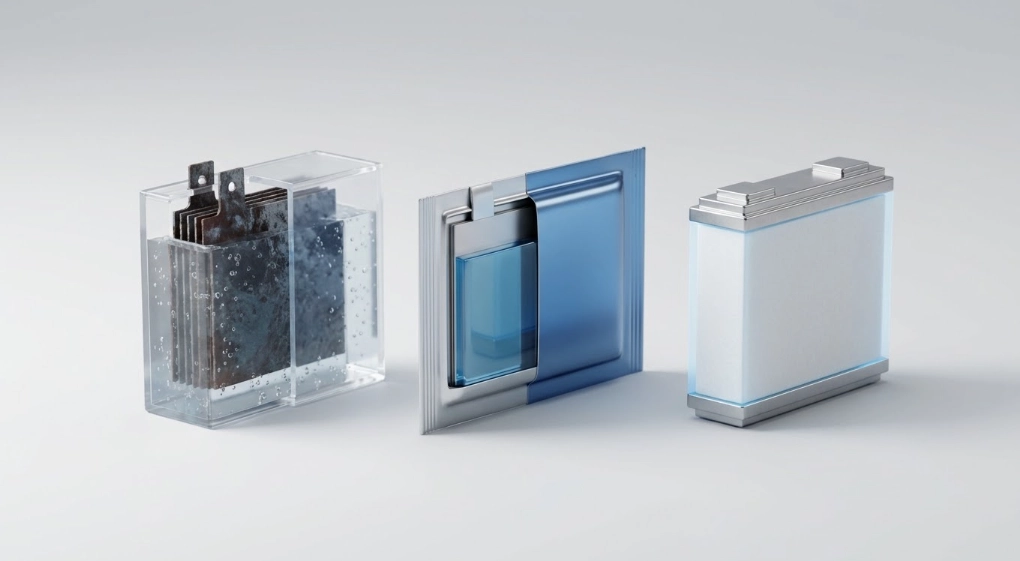
Traditional lithium-ion batteries rely on a liquid organic electrolyte to shuttle lithium ions between the cathode and the anode. While this liquid provides excellent ionic conductivity, it is inherently flawed: it is highly volatile, flammable, and susceptible to degrading over time. Furthermore, liquid electrolytes prevent the use of pure lithium metal as an anode due to the formation of “dendrites”—microscopic spikes of lithium that grow during charging, eventually piercing the separator and causing catastrophic short circuits.
Solid-state batteries replace this liquid with a solid ion-conducting material (a solid electrolyte). This substitution unlocks three massive advantages:
- Unprecedented Safety: Solid electrolytes are generally non-flammable. The risk of thermal runaway is virtually eliminated, which drastically reduces the need for heavy, complex cooling systems and fire-suppression mechanisms within the battery pack.
- Lithium Metal Anodes: Because a rigid solid electrolyte physically blocks dendrite growth, manufacturers can use pure lithium metal anodes. This creates a massive leap in energy density, pushing boundaries beyond 400 Wh/kg and 1000 Wh/L.
- Wider Operating Temperatures: Without liquids that freeze in the cold or vaporize in the heat, solid-state cells can operate reliably in extreme environments, from sub-zero aerospace applications to high-heat industrial settings.
2. Deciphering the Solid Electrolyte Triad
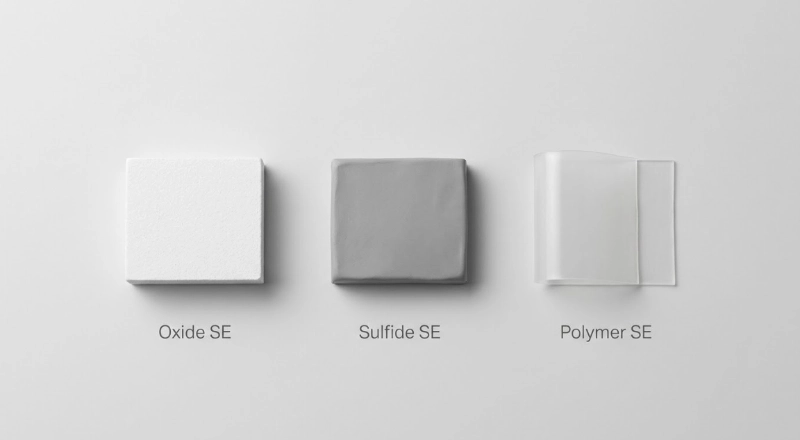
The most critical decision in your sourcing journey is selecting the right solid electrolyte chemistry. The term “solid-state battery” is an umbrella term; the actual performance of the cell is dictated by whether it uses an Oxide, a Sulfide, or a Polymer.
A. Oxide-Based Solid Electrolytes
Oxides (such as LLZO and LATP) are ceramic materials. They are the undisputed champions of safety and stability.
- The Good: They are chemically inert, completely non-flammable, and resistant to oxidation at high voltages. They are ideal for harsh environments and consumer electronics.
- The Challenge: Ceramics are brittle. Achieving good contact between a rigid ceramic electrolyte and rigid electrode particles is difficult, leading to high interfacial resistance. They also require incredibly high-temperature sintering during manufacturing, making them expensive and difficult to scale into large EV-sized cells.
B. Sulfide-Based Solid Electrolytes
Sulfides (such as LPS and argyrodites) are currently the leading candidates for the automotive industry.
- The Good: They are soft and deformable, which means they can be pressed tightly against electrodes to create excellent, low-resistance contact. Their ionic conductivity at room temperature is phenomenal, often matching or exceeding liquid electrolytes.
- The Challenge: Sulfides are highly reactive with atmospheric moisture. Exposure to even trace amounts of humidity causes them to release toxic hydrogen sulfide ($H_2S$) gas. Consequently, they must be manufactured in ultra-dry environments, driving up facility CapEx.
C. Polymer-Based Solid Electrolytes
Solid polymer electrolytes (SPEs) are the most commercially mature, having been used in niche applications (like commercial buses) for years.
- The Good: They are flexible, easy to manufacture using existing roll-to-roll equipment, and relatively inexpensive.
- The Challenge: Most polymers have terrible ionic conductivity at room temperature. To work effectively, the battery pack must be pre-heated to 60°C – 80°C, which drains internal energy and complicates the system architecture.
Technical Comparison Matrix
| Specification | Traditional Li-ion | Oxide Solid-State | Sulfide Solid-State | Polymer Solid-State |
|---|---|---|---|---|
| Max Energy Density | ~280 Wh/kg | ~400 Wh/kg | ~450+ Wh/kg | ~300 Wh/kg |
| Room Temp Conductivity | Excellent | Poor to Fair | Excellent | Very Poor (Needs Heat) |
| Mechanical Flexibility | High (in pouches) | Very Rigid / Brittle | Moderate | Highly Flexible |
| Manufacturing Env. | Standard Dry Room | High-Temp Kilns | Ultra-Dry / Argon | Standard Dry Room |
| Best Application | Universal | Wearables, Drones | EVs, Heavy Transport | Grid Storage, Buses |
3. Essential Procurement Considerations for 2026 and Beyond
As you transition from standard LFP or NMC lithium-ion cells to next-generation tech, your vendor evaluation matrix must evolve. Navigating the landscape of solid-state battery procurement considerations requires supply chain executives to look far beyond simple cost-per-kWh metrics.
Semi-Solid vs. All-Solid (ASSB)
You must clarify exactly what you are buying. Many manufacturers currently market “solid-state” batteries that are actually semi-solid or hybrid. These cells contain 5% to 10% liquid electrolyte to lubricate the internal interfaces and lower resistance.
- Semi-solid cells are highly viable right now. They offer a great stepping stone with improved safety and density.
- All-solid-state batteries (ASSB) contain absolutely zero liquid. While they offer the ultimate theoretical performance, they are harder to source in high volumes and are prone to manufacturing defects as of 2026.
Manufacturing Readiness Level (MRL)
When auditing a supplier, demand to see their automated production lines, not just their R&D lab. Can they produce solid electrolyte films that are uniformly thin (under 30 microns) without pinholes? Can they achieve a manufacturing yield rate above 90%? If a supplier is only producing 1Ah pouch cells by hand, they are not ready for a 100MWh commercial automotive contract.
Supply Chain Localization and Raw Materials
Solid-state batteries rely on specific, highly refined precursors. Sulfides require battery-grade lithium sulfide (Li_2S), which is currently expensive and heavily centralized in a few geographic regions. Oxides require metals like Lanthanum and Zirconium. Evaluating your vendor’s upstream supply chain security is a non-negotiable part of modern procurement.
4. Navigating and Mitigating Project Risks
The integration of solid-state technology is mechanically and thermally complex. Engineering teams must work in lockstep with procurement to ensure the chosen cell can actually be integrated into the final product. Unforeseen battery project risks can derail product launch timelines and inflate R&D budgets exponentially.
The Stack Pressure Dilemma
This is the single biggest engineering hurdle. Solid materials do not flow. When a solid-state battery with a lithium metal anode charges, the anode expands significantly in volume. When it discharges, it contracts. If the battery is not kept under immense physical pressure (often between 2 to 5 MPa, equivalent to the weight of a car resting on a small coin), the solid layers will pull apart. This delamination causes a massive spike in internal resistance and instantly kills the battery’s capacity.
To mitigate this, engineers must design heavy, complex battery enclosures equipped with spring-loaded compression plates, foam pads, or pneumatic tensioners. This added weight at the pack level can negate the energy density gains achieved at the cell level.
Cycle Life Discrepancies
Be wary of cycle life claims on datasheets. A supplier might claim 1,000 cycles with 80% capacity retention, but this data is often generated under highly controlled conditions (e.g., extremely slow charge rates, perfect temperatures, and massive laboratory presses applying pressure). In the real world, temperature fluctuations and dynamic charging loads can induce micro-cracking in the brittle solid electrolytes. You must demand testing data that reflects your specific product’s duty cycle.
5. A Phased Integration Framework
To successfully source and integrate solid-state tech, follow this structured roadmap:
- Application Profiling: Determine your non-negotiables. If your product needs to operate in -20°C weather without a heavy heating system, polymer electrolytes are out. If you are building a flexible wearable device, rigid ceramic oxides will fail.
- Mechanical Feasibility Study: Before signing a purchase agreement, have your mechanical engineering team calculate the space and weight required for the external compression system (stack pressure).
- Sample Validation: Procure B-sample cells and subject them to extreme abuse testing (nail penetration, crush, thermal ramp) in your own facilities to verify the supplier’s safety claims.
6. The Impact of 2026 Industry Standards
A critical factor shaping the market today is the formalization of solid-state battery standards. As major markets (notably China, the EU, and the US) roll out stringent regulatory frameworks in 2026 regarding testing protocols, thermal runaway propagation, and end-of-life recycling for ASSBs, the sourcing game has changed.
Integrating these new 2026 standards into your solid-state battery procurement considerations is non-negotiable. Cells that fail to meet these new international standards for mechanical shock, pressure cycling, and H_2S emission limits will be barred from commercial deployment. Ensure your supplier’s roadmap explicitly includes third-party certification against these specific 2026 solid-state mandates.
7. Conclusion
The transition to solid-state energy storage is a complex but highly rewarding endeavor. It promises to redefine the boundaries of electric mobility, aerospace, and portable power. By deeply understanding the differences between oxide, sulfide, and polymer chemistries, maintaining a strict audit of manufacturing readiness, and planning for mechanical pack-level integration, your organization can successfully navigate this disruption.
We hope this solid-state battery buyer guide has illuminated the path forward, providing you with the analytical tools necessary to select the right technological partner while aggressively minimizing your battery project risks. The future is solid, and the time to prepare your supply chain is now.
FAQs
Q1: Why can’t I just replace my current lithium-ion cells with solid-state cells of the same size?
A: Solid-state cells are not “drop-in” replacements due to their unique mechanical and thermal requirements. Unlike liquid-based cells, solid-state batteries (especially those with lithium metal anodes) require constant, high external physical pressure (stack pressure) to prevent internal layers from separating during charge/discharge cycles. Upgrading to solid-state requires a complete redesign of the battery pack enclosure to include compression mechanisms.
Q2: What is the main safety hazard of sulfide-based solid-state batteries?
A: While sulfide solid-state batteries eliminate the highly flammable liquid organic solvents found in traditional Li-ion batteries—drastically reducing fire risk—they introduce a different hazard. Sulfide electrolytes are highly sensitive to moisture. If the cell’s hermetic seal is breached and the internal materials are exposed to ambient humidity, a chemical reaction occurs that releases hydrogen sulfide ($H_2S$), a highly toxic and corrosive gas. Battery packs must be designed with gas venting and sensing safety protocols.
Q3: Are “semi-solid” batteries just a marketing gimmick, or do they offer real value?
A: Semi-solid (or hybrid) batteries are a highly valuable, commercially viable transition technology. By incorporating a small amount of liquid or gel (usually 5-10%) into the solid matrix, manufacturers can significantly improve ionic conductivity and interfacial contact without needing extreme stack pressure. This allows them to achieve higher energy densities and better safety than traditional lithium-ion, while still utilizing existing manufacturing equipment, making them an excellent choice for near-term projects.