









Solid-State Battery vs Lithium-Ion Battery
Release time: 2026-06-22
Table of Contents
The global transition toward clean energy, electric mobility, and advanced portable electronics has triggered an unprecedented race for superior energy storage solutions. For decades, the liquid-electrolyte lithium-ion cell has been the undisputed king of energy storage, powering everything from smartphones to electric vehicles (EVs). However, as we push the physical limits of current chemical frameworks, a newer technology is emerging to challenge the status quo.
1. Understanding Lithium-Ion Technology: The Modern Standard
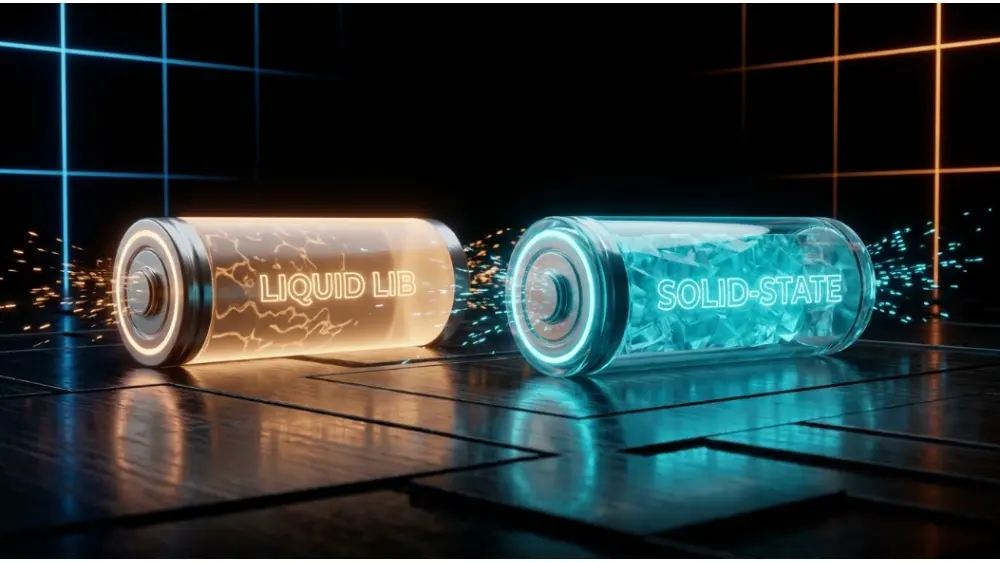
To understand why the energy sector is buzzing with excitement over next-generation alternatives, we must first examine the workhorse of modern electronics: the liquid lithium-ion battery (LIB).
How Liquid Lithium-Ion Cells Work
At its core, a standard lithium-ion cell consists of four main components:
- Anode (Negative Electrode): Usually made of graphite or a silicon-graphite composite.
- Cathode (Positive Electrode): Typically composed of transition metal oxides such as Lithium Nickel Manganese Cobalt Oxide (NMC) or Lithium Iron Phosphate (LFP).
- Liquid Electrolyte: A chemical solvent containing dissolved lithium salts that allows lithium ions (Li+) to move back and forth between the anode and cathode during charge and discharge cycles.
- Separator: A thin, porous plastic membrane that physically keeps the anode and cathode apart to prevent short circuits while letting the liquid electrolyte pass through.
During charging, lithium ions move from the cathode through the liquid electrolyte to the anode, where they are stored. During discharging, the reverse happens, releasing electrical energy to power the external device.
The Limits of Liquid Electrolytes
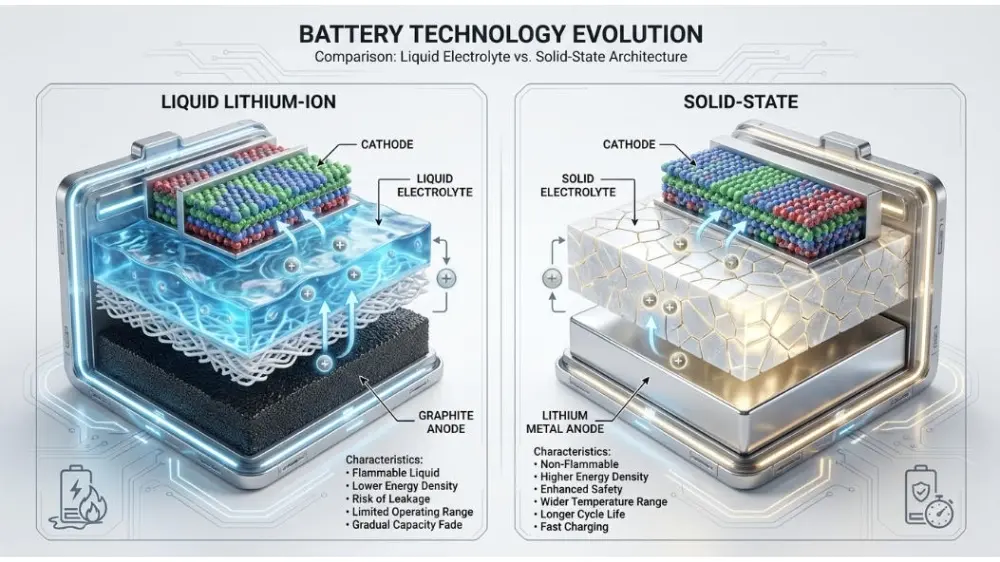
While liquid LIBs have undergone massive optimization, they are approaching their theoretical limits in terms of energy density (typically capped around 260–300 Wh/kg). More importantly, the organic solvents used in the liquid electrolyte are highly volatile and flammable. Under situations of mechanical damage, manufacturing defects, or overcharging, these cells can suffer from thermal runaway—a catastrophic feedback loop leading to fires or explosions.
Additionally, liquid systems suffer from degradation due to the formation of solid electrolyte interphase (SEI) layers and lithium dendrites (tiny needle-like structures) that can pierce the separator over time, causing internal short circuits and shortening the overall lifespan.
2. What is a Solid-State Battery?
To overcome the inherent physical bottlenecks of liquid systems, researchers developed the concept of a solid-state battery. This technology replaces the volatile liquid organic solvent and the polymer separator with a single, robust solid compound.
+-------------------------------------------------------------+
|                Solid-State Architecture                     |
|                                                             |
|  [ Cathode ] ====> [ Solid-State Electrolyte ] ====> [ Anode ]|
|                    (Ceramic/Polymer/Sulfide)               |
+-------------------------------------------------------------+
The Role of Solid Electrolytes
By utilizing a solid-state electrolyte (SSE) made of ceramics (such as LLZO), glasses, sulfides (like LGPS), or solid polymers, the physical design of the cell changes dramatically:
- No Liquid Flammability: The volatile organic solvent is completely eliminated, neutralizing the risk of explosive thermal runaway.
- Inherent Separator Properties: The solid electrolyte itself acts as the barrier, preventing the cathode and anode from touching.
- Compatibility with Lithium Metal Anodes: Because solid electrolytes are physically rigid, they can theoretically suppress dendrite growth. This allows the use of pure lithium metal as an anode instead of graphite. Since pure lithium metal has an extremely high theoretical capacity (~3,860 mAh/g compared to graphite’s 372 mAh/g), this shift unlocks massive energy density potential.
3. Comprehensive Performance Comparison Matrix
To gain a clear, structured view of how these two competing architectures stack up against each other, we have prepared a detailed battery comparison table. This matrix examines key metrics based on current production standards and anticipated pilot-scale achievements.
| Evaluation Metric | Liquid Lithium-Ion Battery (LIB) | Solid-State Battery (SSB) |
|---|---|---|
| Electrolyte Phase | Liquid (Organic Carbonates) | Solid (Ceramics, Sulfides, or Polymers) |
| Anode Material | Graphite or Silicon-Graphite | Silicon, Anodeless, or Pure Lithium Metal |
| Typical Energy Density | 150 – 280 Wh/kg | 350 – 500+ Wh/kg (Projected) |
| Safety Profile | Moderate (Susceptible to Thermal Runaway) | Very High (Non-flammable solid electrolyte) |
| Fast Charging Time | 30 – 60 minutes (To 80% SoC) | 10 – 15 minutes (Indicated in lab/pilot) |
| Operating Temperature | Narrow (0°C to 45°C for optimal use) | Wide (Solid ceramics tolerate higher extremes) |
| Cycle Lifespan | 1,000 – 2,000 cycles (Highly mature) | Variable (500 – 10,000+ depending on chemistry) |
| Current Manufacturing Cost | Low (Highly optimized, ~ $100/kWh) | Very High (Pilot scale, estimated 3x to 5x more) |
| Mass Commercial Scale | Fully Mature (Gigafactory scale) | Emerging (Semi-solid in 2026; All-solid ~ 2027–2030) |
4. The Industry Search for a Reliable Lithium Battery Alternative
As global industries strive for carbon neutrality, the limitations of standard liquid-electrolyte cells have become a bottleneck for heavy industrial applications, aviation, and long-range electric transportation. This critical bottleneck is driving a global push for a viable lithium battery alternative that can offer unparalleled safety alongside unprecedented range capabilities.
While alternative chemistries like Sodium-Ion (Na-Ion) are gaining traction for low-cost, grid-scale storage, they do not possess the high energy density required for premium mobility. Solid-state architectures, on the other hand, represent the holy grail of high-performance energy storage. By keeping the high-energy lithium chemistry but swapping out the liquid transport medium, manufacturers can maximize volumetric efficiency without compromising on safety.
5. Key Differences and Performance Breakdown
To fully appreciate the implications of this technological shift, we must analyze the specific performance metrics where these two battery structures diverge.
A. Energy Density and Volumetric Efficiency
Energy density directly dictates how much power a system can store relative to its physical size and weight.
- Lithium-Ion: Because liquid cells require thick protective packaging, heavy cooling systems, and structural cell-to-pack safety margins to prevent thermal runaway propagation, the pack-level energy density is significantly lower than the individual cell-level density.
- Solid-State: Eliminating cooling systems and heavy thermal barriers means packs can be built much more compactly. When paired with a lithium metal anode, solid-state cells can pack up to 80% more energy per unit volume, translating to electric vehicles with driving ranges exceeding 1,000 km on a single charge.
B. Thermal Stability and Safety
Safety remains the primary concern for large-scale energy deployments.
- In a liquid LIB, an internal short circuit can ignite the liquid organic solvents, releasing oxygen from the cathode and creating an uncontrollable fire.
- Solid inorganic electrolytes do not burn, even at extremely high operating temperatures. This high thermal threshold eliminates the need for complex, heavy liquid cooling loops, reducing the parasitic weight of the battery pack and simplifying vehicle engineering.
       [ Liquid Battery Threat ]                      [ Solid-State Safety ]
   +-------------------------------+             +-------------------------------+
   | Mechanical Impact             |             | Mechanical Impact             |
   |              |                |             |              |                |
   |              v                |             |              v                |
   | Liquid Leakage -> Flammable   |             | No Liquid Leakage             |
   |              |                |             |              |                |
   |              v                |             |              v                |
   | Thermal Runaway (Fire/Smoke)  |             | No Combustion (Intact)        |
   +-------------------------------+             +-------------------------------+
C. Charging Speed and Charge Transfer kinetics
Fast-charging liquid cells too quickly can cause lithium ions to accumulate on the surface of the anode faster than they can intercalate into it, a phenomenon known as “lithium plating.” This plating accelerates dendrite growth and ruins the cell.
- Solid-state systems can tolerate much higher current densities without the same plating risks, assuming the solid-solid interface is highly optimized.
- Some laboratory prototypes have demonstrated the ability to charge from 0% to 80% capacity in under 10 minutes, mirroring the convenience of refueling a traditional internal combustion engine.
6. The Real-World Commercialization Timeline
Despite the incredible promises of solid-state systems, a major gap remains between laboratory breakthroughs and commercial availability. Moving toward this next-gen energy paradigm requires overcoming substantial manufacturing and material hurdles.
The “Semi-Solid” Transition (2025–2026)
As of 2026, the global battery industry is embracing a transitional phase: semi-solid-state (or solid-liquid hybrid) batteries. These cells utilize a solid electrolyte matrix mixed with a tiny percentage of liquid or gel catholyte (typically 5–10%) to ensure proper wetting and ion transfer.
- Production Line Compatibility: One of the main reasons semi-solid chemistry is leading the market is that it requires very low equipment retrofitting capital expenditure—only about 10–15% modification to existing gigafactory lithium-ion production lines.
- Real-World Vehicles: Automakers like NIO have already rolled out high-density semi-solid packs (e.g., NIO’s 360 Wh/kg pack), and brands like MG, Chery, and Dongfeng are implementing semi-solid options in vehicles by late 2026.
The “All-Solid-State” Era (2027–2030 and Beyond)
True all-solid-state batteries (containing 0% liquid) are much harder to produce at scale.
- The Solid-Solid Interface Challenge: Getting solid materials to contact each other perfectly at the atomic level without micro-gaps is incredibly difficult. During charging and discharging, the anode and cathode physically expand and contract. Without a liquid to fill the gaps, these volume changes cause the solid layers to delaminate, causing the battery to quickly lose capacity.
- Manufacturing and Yield Rates: All-solid-state production requires completely dry room environments and high-pressure manufacturing steps that are currently incompatible with legacy lithium assembly lines.
- Roadmaps: Major players like BYD, CATL, and Toyota have set timelines to start small-scale production and prototype testing of sulfide-based all-solid-state batteries around 2027, with high-volume, mainstream automotive mass production expected around 2030.
7. The Future Verdict: Coexistence or Complete Domination?
Will the solid-state architecture completely wipe out traditional liquid batteries?
In the high-end automotive, aerospace, and high-performance military sectors, the newer solid technology will likely become the premium gold standard. However, due to the extreme cost-efficiency, mature manufacturing ecosystems, and lower cost-per-kilowatt-hour of traditional liquid batteries (especially LFP variants), they are highly unlikely to disappear anytime soon.
Instead, we will see a segmented market. For budget-friendly, mass-market electric vehicles and stationary grid energy storage, highly optimized liquid-electrolyte batteries and sodium-ion options will remain dominant. Meanwhile, solid-state designs will power long-range luxury EVs, eVTOLs (electric vertical takeoff and landing aircraft), and critical portable medical devices where safety and volumetric density are worth a premium price tag.
FAQ
Q1: Why are solid-state batteries so expensive compared to traditional lithium-ion batteries?
The high cost of solid-state systems is primarily driven by raw materials and manufacturing complexity. Producing solid inorganic electrolytes (like high-purity sulfides or oxides) requires expensive precursors and specialized processing. Furthermore, assembly must happen in ultra-dry, high-pressure environments, and current production facilities are still at the pilot-line stage rather than the massive, cost-optimized gigafactory scale enjoyed by traditional lithium-ion cells.
Q2: Can a solid-state battery catch fire?
In theory, a true all-solid-state battery is virtually immune to the classic thermal runaway fires seen in liquid lithium-ion cells. Because the volatile, highly flammable liquid electrolyte is replaced by a non-combustible solid ceramic or glass barrier, there is no organic solvent to ignite if the cell is punctured, crushed, or overheated. However, minor safety risks (such as micro-shorting from extreme dendrite penetration) are still being studied, though they result in soft short-circuits rather than explosive fires.
Q3: How soon can I buy an electric vehicle powered by an all-solid-state battery?
While “semi-solid” battery vehicles are already driving on the road today in limited batches, fully “all-solid-state” EVs are not expected to reach wide commercial availability until approximately 2027 to 2030. Initial rollouts will likely target high-end, luxury vehicles from brands like Toyota, Nissan, and premium sub-brands of BYD.